Jackson Nguyen (00:05)
Hi everyone, welcome to the Memories Podcast. I'm your host, Jackson Nguyen, and I'm a biochemistry senior at Worcester Polytechnic Institute in Worcester, Massachusetts. I am also a trained community representative of the Massachusetts chapter of the Alzheimer's Association. Memories is a podcast interview series that features in-depth one-on-one conversations with leading global experts to explore Alzheimer's disease and dementia,
from numerous lenses. Through these conversations, I hope to deepen public understanding of AD and share the voices of those making a difference across the globe. Memories is a personal passion project of mine where I hope to engage in fruitful conversations with experts to learn more about Alzheimer's and dementia and spread awareness of its devastating condition to my local and global community. Thank you so much for joining.
Jackson Nguyen (00:59)
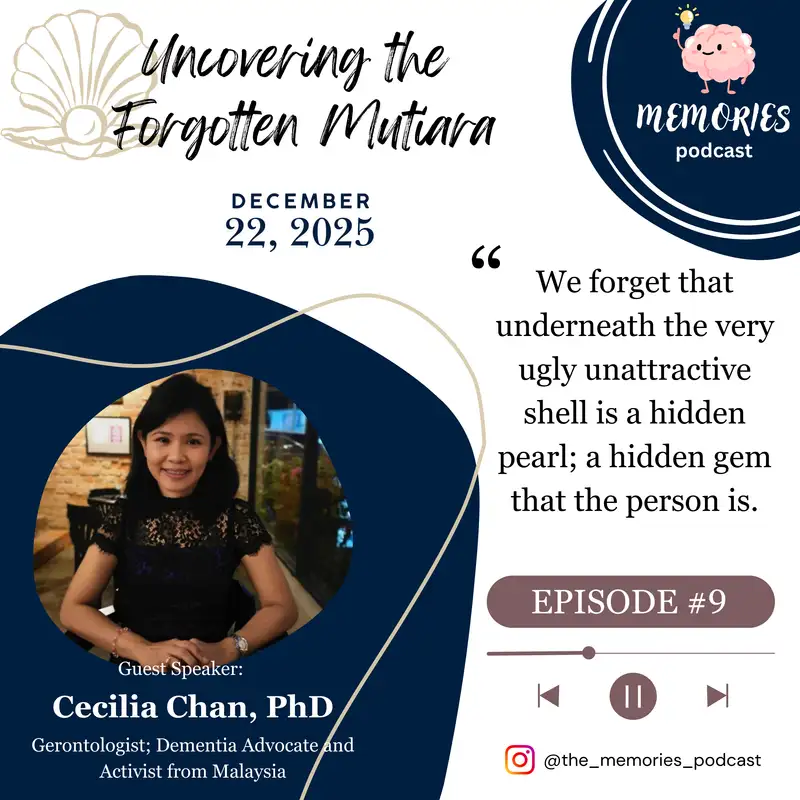
In today's episode, it's an honor for me to welcome Dr. Cecilia Chan, a renowned gerontologist, dementia care specialist based in Malaysia. She has extensive experience in elderly care and has been in the field for over 20 years. She's involved in numerous impactful projects aiming to de-stigmatize dementia and reimagine how society perceives aging, not as a decline, but as a stage of life that holds meaning.
dignity and connection. These projects include the Forgotten Mutiara Cafe, Totsu Totsu Therapeutic Arts, and Dancing with Dementia Retreat, and more, which have been featured in national and international media. It is truly a joy to have you here, Dr. Chan.
Dr. Cecilia Chan (01:43)
Thanks for having me, Jackson.
Jackson Nguyen (01:44)
I guess first off, like how are you doing today, Dr. Chan? What has been keeping you busy lately?
Dr. Cecilia Chan (01:50)
I'm good actually. I have a series of things that's coming up. Actually today at 11, I have another webinar to present in a local university, so I've been busy.
Jackson Nguyen (02:01)
Yeah, and I would love to hear your story into dementia care and gerontology, like what first drew you to gerontology and taking care of the elderly? Like, was there like a personal moment or like light bulb moment that sparked your interest in the field?
Dr. Cecilia Chan (02:17)
Yeah, actually, it's interesting, know, actually, as I reflect, I think I've always been drawn to the fact that the thing that we have in common as human beings, all of us, is that we will age, you know, it's aging process. It's something that we all will experience and we all will go through as we are speaking. Now we are aging. And every human being, no matter
what box of life, what stage of life will experience aging and most of us will eventually die. I mean, that's what we go through. it also intrigues me that we deny this fact and we try to fight it and we make it our enemy and all that when it is a pure fact of life. So I'm very curious to why we are doing this. And also, I guess when I was very young, I've been very drawn to my elders, meaning my
maternal grandmother, my great aunt. I grew up with them. We live in a place, our community that's multi-generational. And I loved it. I loved sitting with them, listening to their stories. Also, I think as I was growing up, my career and all that, I do have mentors who are much older to me and they are very rich in their wisdom and their experience.
And they have shaped me and helped me in a way that I could never get from books or Mr. Google himself. But these are real life experiences that are very rich. And these are the contact resources that we often ignore. So I think that was what intrigued me into sort of, and drove me into this field, actually. Yeah, it was very personal.
Jackson Nguyen (03:58)
Yeah, thank you so much for sharing Dr. Chan and your journey into gerontology is definitely very inspiring. And I'd love to zoom out now and like talk about, you know, the broader context and what aging actually looks like in Malaysia. Like, how would you describe Malaysia's aging population today?
Dr. Cecilia Chan (04:15)
So we have actually crossed that threshold into an aging society. We have definitely crossed beyond 7%. We are now reaching about 10 % of our population, 65 and above. And it has changed the way we view aging.
has transformed and has evolved and has changed. And I would say that the Malaysians who are experiencing aging are also experiencing in a very different way from the people who were experiencing it like 20, 50 years ago. So there's a lot of changes that's going on in this Malaysian aging population, the way we see it.
the way we project it and also the way people are experiencing it.
Jackson Nguyen (05:11)
And do you think Malaysia is prepared for an aging population?
Dr. Cecilia Chan (05:15)
Yeah, that is my personal opinion, is a strong no. We are definitely very ill prepared in whatever way. Unfortunately, most of the conversations that we have when we talk about, yeah, Malaysia is now an aging population, how do we address that? Immediately, we will think about nursing home and institutions. I mean, that's a very myopic way of looking at it. We have to look at the whole structure.
We have to look at it from the human resources, the policies, the healthcare, prevention, the community. What can we do to sort of support this growing population so that everybody can benefit from it and ⁓ will be able to live their life to the fullest as we grow in age? And I do not see that Malaysia is actually ready to
to embark this transformation and the changes. We are not prepared effectively. So that's again, that's my personal opinion.
Jackson Nguyen (06:11)
Yeah. And do you think like, are there any like policies or any like initiatives? I know like you've definitely been a driver in the field trying to like, you know, push for all of these transformative initiatives that you're pursuing in Malaysia to like support the elderly and such. But do you think like the government in Malaysia is like supporting in that at all?
Dr. Cecilia Chan (06:29)
It is actually extremely painfully slow in coming. But I have been in this industry a lot and I have been in a lot of meetings, a lot of discussions, a lot. And we are not moving fast enough. Actually, we pretty slow. And we just launched the Dementia Action Plan recently. is a thing about
last year, two years ago. Yeah, so it's Dementia action plan for 2023 to 2030, where we have a series of what can it do, what's our objective and all that. And that was launched. But I'm also pretty skeptical about it because it is done by the so-called experts and I inverted comma and I was part of the people that's invited. But I feel that it is
really drafted like people who are researchers or people who are in the healthcare profession. It does not actually involve people who are actually living it and experiencing it. And so my question is how does that actually impact the day-to-day experience of the people that's living with dementia and their family members and their loved ones and the community? Does it really help people?
so that people can continue to live a good life, a good quality of life. And that's what my issue concern is about. For example, one of the objective is to raise awareness. And I've been in 20 years, raising awareness means every September is a dementia month and their community will have their fun walk or walkathon or whatever, maybe a day, maybe two days. And it's the same people going it.
I mean, attending it is the same group of people and that does not have much impact on the quality of life. It does not address the stigma, it doesn't address the discrimination, it doesn't address how are we going to better support. So my question is that I really feel that we really need to look into how are we going to make impactful changes for those
that's leaving it in particular, we don't have that, unfortunately.
Jackson Nguyen (08:41)
Yeah. And speaking of the stigma aspect that you talk about, cause dementia often, you know, carries very negative connotations, like lost decline and more. how do you think these negative connotations contribute to the stigma around dementia culture and Malaysia?
Dr. Cecilia Chan (08:59)
it's really very stigmatized in Malaysia. Dementia is the almost dirty word. And it really has an impact on the care that we provide. If you just focus on the loss, focus on what the person cannot do anymore. And we use words like a living dead, know, or zombie when it comes to dementia.
We stop looking at them as a person anymore. So imagine if I were to take care of somebody who has dementia and to me, a person with dementia is just a task to be fulfilled. I just have to perform my task. I have to bathe her. I have to make sure she has to take a bath, she take a food, she take her medication and she take a sleep and all that. It's just a list of things to do and I fail to look at the person.
And unfortunately, because of the stigma, actually, unfortunately, abuse is pretty common in care. Physical restraint and chemical restraint is still widely accepted as a practice in Malaysia, unfortunately. So it's very common to have, for example, hospitals, when you have a patient and
diagnosed with coming and had a fall or something and the person is living with dementia, it is almost a practice that you will have your restraints ready. Almost, know, without knowing more. So it's like a practice and it's quite an accepted norm in Malaysia. So, ⁓ yeah, it has a very, very direct negative impact on the way we care for people with dementia, whether it's in facilities, whether it is hospital care, health care and all that.
has a direct impact and that's why I'm working, me are working very hard to change that.
Jackson Nguyen (10:39)
Yeah, and like what do you think has gotten us to that point?
Dr. Cecilia Chan (10:43)
Well, I think stigma is something that we create. I mean, you know, it's socially constructed. It's constructed idea. It's not something that is real. And I think if you look at that, there is a lot of influence from the media, even from the awareness, know, so-called awareness when we create an awareness, what kind of awareness are we giving?
I mean, we're giving a very negative image of a person, know, even the poster, simple things like a poster, you just look at the pictures and all that is fading, something your brain are vanishing away. That kind of image that we give are very negative. And I think it's because it's so medically dominated in Malaysia. So we kind of look into the experts like doctors and all that. And we don't blame the medical community because they are trained to look at illness.
They are trained to look at the amyloid plaques and how tangles and what you know, part of the brain is atrophy. And so we look at that and we forgot that the person is a person first. So and I think that's because of these influences, the media portrayal that has slowly created dementia into something that is the most stigmatized condition in Malaysia.
Jackson Nguyen (11:52)
Yeah, like previously when you said how, you know, like our society prioritized like tasks instead of people, I totally agree with you. I feel like this is also really similar here, like here in the United States, because like me as a patient care assistant at a local nursing hospital that I work at, I feel like some of the staff sometimes they are, you know, even with the resident right in front of them, they,
kind of just go inside the room and kind of just do the task like a checkbox, like just check off the task that they need to do, but like forgetting that the resident is right in front of them and not even like interacting with them or kind of just go in there and like doing whatever they need to do and leave. And I don't know, it's really unfortunate, but I think it's important that we transform it for the future.
Dr. Cecilia Chan (12:41)
today. Yes.
Jackson Nguyen (12:42)
And in response to these challenges and stigmas, I know you've taken actions in incredibly meaningful ways. I'd love to talk about the advocacy and the community work that you're doing. And what does dementia advocacy look like in practice for you? What type of activities or projects are you involved in to advocate for those with dementia?
Dr. Cecilia Chan (13:03)
Yeah, in Malaysia, in Malaysia, dementia doesn't have a voice. It's pretty voiceless. So I decide that I will try to be the voice for the voiceless. So my advocacy work has actually now transformed into focusing on the roots. So I go to community. And I think that works better than me going to the policymakers and the politicians. I have wasted a lot of tons of time with them.
I decided to focus on the community themselves. That's where change will begin and quite immediately. So my work is directly with the root people. People living with dementia and the care partners and different communities wherever they are small communities. And I hope that we will have then create a little pockets of community that has transformed into a community that is an inclusive community and all that.
And ⁓ I feel that small groups in the community can then begin to feel the changes. And that is why my projects involve directly people living with dementia, the care partners, family members, volunteers coming together as one and sharing moments of joy, sharing moments of shared humanity actually, and just being there. And when people experience
it rather than me giving a talk or going for a conference, the experience has got a direct impact. It changes the way you look at it. And it's very profound because it changes you, you know, deep within. So a lot of my advocacy works deal directly at the the root of the community now, actually.
Jackson Nguyen (14:41)
Yeah. And I know one of your most beautiful initiative that I recently learned about was, the forgotten Mutiara, the pop-up cafe. I would love if you could speak more about that. what was the inspiration behind this initiative and what's like the underlying meaning behind like the forgotten Mutiara? It sounds so powerful.
Dr. Cecilia Chan (14:59)
Yes, well, Mutiara is our Malaysian word, Malay. Our national language is Basa Malaysia. So Mutiara in Malay, means pearl. That we forgot that the pearl. So when we look at pearl, actually, if you look at the very ugly, ⁓ unattractive shell, we like it disgust us, right? But then we forget
that underneath the very ugly unattractive shell is a hidden pearl, a hidden gem that the person is. And I think it's sort of kind of symbolized how we look at dementia in Malaysia. So we call it the Forgotten Mutiara as in the Forgotten pearl. Let's reclaim the pearl. And so we decided to name our pop-up cafe that. The reason why I did that because in our daycare facilities, our members
They are diverse, but they all have talents. Every one of them, just like you and I, you you're very good in broadcasts and all this, and I'm really bad at it, you know. So when we work together, we focus on the strength, your strength and my strength, right? It's the same as in the Pop-Up Cafe. A lot of them are retired chefs.
They barista, they make coffee traditional way, they make cookies and cakes. Most of them are housewives, cook their entire lives. So we sort of, why don't we turn it into a pop-up cafe and then we serve the traditional meals that these people are very good at. So we decide on, we sit down and have a meeting, all of us, and we decide what kind of menu you want to have, what is the team we like, the beverages.
So then we draw up the menu and then we assign jobs who will do what, who is very good at making beverages, who is very good at cooking, who loves to serve and PR work. And so we assign, so we are all the crew, you know, and we open it to the public. Of course you have to pre-register because we can't handle too much crowd or we need to know how many people we are serving. Also people come in like an ordinary cafe and we serve them and then...
We sit down with them and then you will music. We were dancing traditional games, just being with each other, sharing the moments. And we do it perhaps every couple of months. And I think that itself has created a lot of impact for all of us. Each time we have new experience, each time we will be touched in very, very different way. And people feel it very differently.
and the fellowship is pretty intense. And so we have been doing it for the past two years, actually.
Jackson Nguyen (17:36)
that is so powerful. I love that so much.
Dr. Cecilia Chan (17:39)
Yes, so we have this and it's also intergenerational. So we have kids coming in. have people like you coming in. We have the old and the young. also we would have our traditional Malay songs. We would do our traditional dance maybe. And so the young people will then bring in their guitar and strung a few and then we will dance together. We will have our traditional games together. And these are the things that bind us as Malaysians, no matter what age.
no matter what cognitive levels we are. Dementia is not in the room. We're just sharing moments of joy. We have our good food, we have our music, we don't need to assess our cognitive ability for that. Everybody can just join in and have the fun. Also, I think that is very powerful. It's a very powerful experience. A lot of people will transform after that.
Jackson Nguyen (18:28)
That's incredible. Thank you so much for sharing Dr. Chan. And I know other initiatives you've been involved in is like the Totsu Totsu Therapeutic Arts or like the dancing with the Dementia Retreat. Could you also share with us some of the powerful takeaways that you've learned from those initiatives and like what inspired you to create them?
Dr. Cecilia Chan (18:46)
Yeah, Totsu Totsu is actually from Japan, right? And I stopped them during the lockdown. When we experienced the pandemic lockdown, I felt very handicapped because we couldn't gather, we couldn't do our memory cafe and everybody is locked up in their homes. And I can see that they declined very sharply because they don't have the interaction. People living with dementia and cognitive decline, they actually declined and progressed very, very
⁓ sharply during the lockdown and I was thinking how then, how could I engage them and I got in touch with this group who did Totsu Totsu in Tokyo and they have been using their dance as the way to engage and connect in people who are having maybe learning difficulties and all that but eventually they also brought it to the nursing homes and for people who are living with cognitive changes.
and so they go to the nursing home and perform the tutsu with them but then during the pandemic they did it online right with the you know and I was like if they could do it online in dementia you don't need a language right I mean dementia we really do not need to speak English or Basa it is the connection that matters and then I said and I got in touch with them I said hey can you just can you do it with us Malaysians too who are living you know and that's how it started
And so we do it online and then they came to Malaysia, we went to Japan. So there's this continuous collaborative work with this Totsu Totsu team from Japan. And that they come to Malaysia and we have conduct workshops and training to use this as a way to connect. And that's how we started. And the retreat we did last year because I was really
annoyed and ⁓ very frustrated when people tell me that people living with dementia they get aggressive. We label them you know if they are aggressive, BPSD, know so they are impaired and we label them and I say that that's the problem when we start labeling people we do not see the person as the person they are just human beings like you and I with needs. The only difference is they cannot vocalize their needs like us.
But then I decided that these people do not have the opportunity to go out, to go for holidays. They're always cooped up in their house or in their nursing home. And I said, why don't we bring them to a resort? You know, so that was in Penang. We're by the beach. We take them to a beach resort. Immediately everybody says, yeah, everybody says, Cecilia, are you crazy? I mean, I didn't get very good response. Actually, I got very negative response.
And most of the people think that I was really out of my mind. It is impossible because new environment will trigger them and then they will get disorientated. They will run away. They will, how are the heck are you going to control them? They're going to spend the night in the resort. And I totally disregard all that. I think it's nonsense because I these people. These are my friends. These are my buddies. I know about them. I know ⁓ what triggers them. I think that's a bunch of rubbish. So I worked with my
my group and their family members and I didn't have any money so we actually had to raise funds you know we had to do a lot of campaigns to raise the money because I had to bring in volunteers you know that it involves a lot of costs so I had to raise funds in order to get the money and but we did it last year at this year actually beginning of this year and the Totsu Totsu gang from Japan joined us you know and we facilitate in during the weekend and I tell you
That was the most, one of the miraculous moment of my life to see them. And I was right, you it proved me right. Nobody was disorientated. Nobody was educated. Everybody was so into the moment. They shared the moment. We even go to a room of this couple living with dementia because the daughter had to go for an annual dinner and she had to come back very late. So we had to babysit them and we sat them.
in their rooms, they were not agitated, they were not disorient. We were just having fun, we were chatting, we were playing games and they even told us that you know, that see the bed is so big and you don't have to go anywhere, why don't you sleep with us here? You know, that was the moment that because we have this relationship, they may not remember who I am exactly but you know, it was quite interesting because one of my clients, my friend living with quite advanced dementia, she's got problem with words, she was telling me she recognized us.
staff but she to her is like okay that is auntie, that is uncle, that is cousin so in her mind we are all family and I think that was that's it touches me that she cannot have no idea okay you are the you know that we are the staff and all that she can't remember names for sure but she knows that they belong to each other that sense of belonging that that was really
a very impactful, meaningful moment in my life. I'm so glad we did it, Jackson.
Jackson Nguyen (23:34)
That is so beautiful. when you said like the unmet needs, I feel like those are predominantly, you know, that leads to a lot of the behavioral symptoms that we don't often, you know, think about. Because I can't imagine if I was a resident being locked up in a place. So sometimes, you know, people refer to this as like a prison in some way, because if I were to be locked in a room,
I would definitely get agitated. feel like that's a normal human response. And we were like, why is this resident getting agitated? Okay, let's give him some medications, know, kind of like sedate him and calm him down. Like that's not going to be the solution because you're just locking him in that room. Like, and so I feel like it's very common sense, but like, feel like society, we don't,
Dr. Cecilia Chan (24:15)
We have lost the common sense. Absolutely, you're so spot on. Yeah, that's why I feel that it's not whatever that I do, it's not rocket science. You know, don't have to go to university and get do a tons of research to prove this. It's common sense. None of us would like to be in the position. So why is it ⁓ that when they behave in a way, then we regard it as ⁓ behavioral symptoms of dementia?
Jackson Nguyen (24:17)
Yeah.
Dr. Cecilia Chan (24:41)
When it's okay, I mean there's this double standard. It's okay if I feel that, let's say if I go to a on a date and I feel very uncomfortable or go for a party and I really feel out of place, it's not my thing and I want to escape right, I want to get out because I feel very uncomfortable. It's very normal for us but then when a person with dementia in a situation feels uncomfortable, want to go home, that becomes a problem. Go figure.
Jackson Nguyen (25:04)
Yeah. And like while we're at it, like, ⁓ I would love to hear your perspectives on, know, between like pharma versus non-pharma approaches to dementia care. when I was talking to Dr. Power, he's a big advocate into, you know, non-pharmaceutical approaches, no pills, because he's saying how, you know, pills can be really dangerous and toxic. And cause we're society, we're using, you know, medications as sort of like a bandage approach.
into how we're dealing with all these symptoms, ignoring all these unmet needs. And so would love to hear your thoughts on the risk of relying on medications to manage these Dementia-related behaviors.
Dr. Cecilia Chan (25:42)
Yeah, unfortunately, that's very, common in Malaysia. The first thing we think about is, OK, where's the drug? What drug is it on? And also, if I refer a case, for example, to a facility, immediately they want to know what are the drugs. Is it on sedative? How do we sedate them? So that becomes a list, you know. So yeah, definitely in Malaysia, overly medicating.
people living with dementia. Just yesterday I had a call of Cecilia, how do we handle this? My client, know, she's so aggressive, what should I do? He's already on 10 medications and he's still aggressive. And yet the person is not able to, so like, hello, doesn't it tell you something? That's not the problem. What are these issues, you know, we need to sort of look at the issues. So it is
Jackson Nguyen (26:21)
Yeah.
Dr. Cecilia Chan (26:28)
unfortunately in Malaysia is very common so I call it the chemical restraint I mean we physically restrain them, we tie them up and then on top of that we also use chemical restraints and it is unfortunately used too often and I think it has been abused I would use the word abuse
that we over-medicate people and then there is a side effect of the medication and then we take another medication to manage the side effects. So then we go on and on and become polypharmacy and then the person will eventually become less than a person, not because of the dementia but because of the side effects of the medications that we put them on.
Jackson Nguyen (27:05)
For sure. Cause like when you said, you know, some patients, they could be over like 10 medications or more because like a lot of times, you know, in especially patients who is like over 65, you know, they could be doing not just only dementia, like, you know, hypertension, diabetes. And so they could be taking all those medications, manage those in addition to, know, medication to deal with their, um, know, anxiety, I don't know, or the depression that we give them. And do you think there's any
pharmacology in terms of like how medications interact with each other like negatively if we take them like all together if especially if they're taking you know like 15,
Dr. Cecilia Chan (27:40)
Definitely. Yes. Yes. As you know, if I'm already on my medication, which has got, all medication has got side effects, right? I mean, there's no medication that has got zero side effects. And I'm going through the side effects. And on top of that, I didn't have enough sleep, or I'm anxious, or I'm agitated, or I'm depressed. We all go through that, human beings, you know, emotions. Sometimes we are not in a good mood. Sometimes we are pissed with our spouses, or...
you know, we get disappointed, we get hurt, we all go through that emotions but somehow when people living with dementia go through that emotion becomes a problem to us. Why can't a person be depressed? We feel that today I'm not going to get out of bed, I'm going to sleep in until maybe, you know, I'm going to skip lunch today, I don't feel like eating or today I'm going to not going to bathe in the morning, I feel like I'm going to skip it and perhaps I'll take bath later in evening.
That's normal for us, right? We do that all the time. But then people living with dementia, we want them to do the list of things that we decide that is because we have a list of things for them to do and there's a certain timetable and we want them to sort of meet into our schedule. And then when they don't, that becomes a problem. That's, you know, so I think we really have to acknowledge that.
maybe because we are so myopic and we become very task-oriented that we forget that the Mutiara that is hidden. is why we want to sort of reclaim back the Mutiara.
Jackson Nguyen (29:03)
Yeah. And like, do you often like collaborate with like other, you know, physicians? Cause as a gerontologist yourself, do you collaborate with like doctors and nurses? Do you take care for like the residents at like the nursing home or like at the hospital?
Dr. Cecilia Chan (29:17)
Yeah, I do have a few very dedicated, I'm happy to say that dedicated, doctors, geriatricians that support my work and we work very, that's really helpful because then, yes, yes, and we work together as a team because in dementia you need a team, you can't, it's not a long-ranger task, know. So I do have
some geriatricians and some people from the healthcare organization are beginning to acknowledge what we are doing and are working together to transform dementia care. I'm quite happy with that.
Jackson Nguyen (29:55)
Yeah. And I would love to hear, like, your, what are some of the strategies or like the approaches that you personally use to like better connect to some of the residents living at like nursing homes or like these patients of yours and like better meet their needs.
Dr. Cecilia Chan (30:12)
I think it's very, again, we go down to the basic fundamental of human needs. Okay, if I'm gonna bathe you, Jackson, if I'm gonna strip you naked and I'm gonna touch your body, I mean, would you be more willing to let a friend do it or a total stranger do it? Obviously you'll be more comfortable as a friend, right? I mean, so first of all, I have to have your sense of trust.
I have to build a relationship with you. my thing is, it's really a lot of relationship based. You have to be okay with me. That is why when we had the retreat, we didn't have any problems, any issue at all, because we have a relationship with them. So if you have a problem, you know that I'm not going to tie you up. You know that I'm not going to call the police. You know that I'm your buddy. You can rely on me. So feel that in every situation is just like you and I. If somebody, if I'm gonna buy, let's say if I go to a market, no stalls, I will usually will go to a person that's very nice to me and I will go back to the same person if I'm gonna buy chicken or vegetable because this person and I have a relationship. Why would I, there are many other stalls but I would choose these stalls because I have a relationship with him or her and I'll trust her that she will not cheat me and she will. So it's the same. I mean that's basic fundamental
human beings as we are. So I think the core of it is to be a friend and have a relationship with them and everything else will go you know more or less smoothly for all of us, for us and for them if we base it on a relationship.
Jackson Nguyen (31:47)
Yeah, I totally agree, I feel like building that friendship and building that relationship is like so key to like optimal care.
And next, would love to hear about, throughout your years of practice as a gerontologist, what have been some of your most memorable and meaningful encounters with those who experience dementia?
Dr. Cecilia Chan (32:08)
there's so many, there's actually a lot. But I think one of the special moment was this lady who's a friend and she's quite advanced that her language, she's struggling language. I think she's got 10 words and she used the same 10 words to describe almost everything. But that time we had lunch and after lunch we were sitting down and ⁓ we were chatting and we were looking at the clouds sitting in front of the garden.
and she looked at her tummy, it's non-verbal, she looked at her tummy and she says, my well is so high, you know, and she smiled. And I looked at her and I knew exactly what she meant. You know, even though she used the words wrongly, but I knew exactly what she meant. doesn't even, and I looked at her and I looked and I point at my tummy and I said, mine too. And we both laughed and laughed. And that was a magical moment because
You don't have to like, do I have to look at the loss and say, no, you're not using the words correctly. What do you mean? And I try to think, think what do you mean? It's like, no, I know exactly what she meant. We would never do that to a toddler. Right? I mean, the soul, we connect. So I'm not saying that people with dementia are like toddlers. It's just a metaphor that we meet people where they are, as they are.
And when that happens, we create a sort of environment that is wholesome for them as well as for us. I'm happier and my staff and my team are very happy because the environment is very wholesome for all of us.
Jackson Nguyen (33:42)
That's so awesome. And like, how do you personally, you know, like support, like families who may be, you know, experiencing these emotions, let's say as, you know, they put their, you know, family members, their loved ones in like a nursing home, like in a dementia nursing home, like, ⁓ like do you, what like support do you provide for like families?
Dr. Cecilia Chan (34:01)
why I think that support groups are very important so that they do not feel, a lot of them feel very isolated and it's a very lonesome journey because you do not experience that people will not be able to understand it you know so that is why we have this support group that supports the family members and there's a lot of spouses that doing it single-handedly, husband and wife living alone you know and they're all
both also pretty old and it can become very isolating because their friends will begin to disappear. Their networks, their world becomes smaller and smaller and smaller and they themselves put themselves at risk and a lot of health risks and all that. So that is why we kind of create a community of support that they can reach out to maybe another couple that's going through so that they feel that and it's a safe place for you to vent, to curse and say bad words, whatever.
because we're all human beings, sometimes we are frustrated and we want to cry and we want to laugh and so we have created this safe space for people to come together where we don't judge them, where they can be themselves and we support them as they go through their journey.
Jackson Nguyen (35:15)
Yeah, thank you so much, Dr. Chan. And as we start to wrap up our amazing conversation today, what's one lesson through your practice as a gerontologist that has taught you, that you carry with you for the rest of your life as you interact with some of these residents? And what has changed your perspective in terms of how you perceive humanity?
Dr. Cecilia Chan (35:38)
There's one very strong lesson was being in the moment. know, because I think my greatest flaw as a human being is that I am always thinking about tomorrow, planning ahead about what's going to happen later part. And in doing that, I miss the moment. But then if you look in life, when we actually begin to reflect,
It is the moment. It is the moment now that I'm with you fully. This moment will never come. It will pass. And soon it will be history. But if I do not appreciate the moment with you, I'm not there with you. I'm not savouring the moment. So the people living with dementia are truly living in the moment, really. And that's why it's so beautiful to be with them because they help me to ground myself. So when I'm with them enjoying a fruit, cooking something, cutting onion or...
and they looked at it and they look, my god, look at the onion, it's so beautiful, look at the pattern and I'm like so intrigued. I have taken all this for granted. There was one client, they were just admiring the clouds and she says, Cecilia, look at the clouds. And I was trying so hard, I'm really trying so hard to imagine the clouds and I is that a rabbit? It's very atorty. Then she says, no Cecilia, that's the hands of God. Can you see God is painting a beautiful picture for us and that really took me away you know so yeah I think the biggest lesson that I learned from them is to appreciate and be present at the moment not only for them but for myself
Jackson Nguyen (37:08)
Dr. Chan, it has been such a pleasure to be with you today. Thank you so much for sharing your insights, experience, and empathy with us in today's episode. I appreciate you very much. Until next time, take care everyone.