Jackson Nguyen (00:05)
Hi everyone, welcome to the Memories Podcast. I'm your host, Jackson Nguyen, and I'm a biochemistry senior at Worcester Polytechnic Institute in Worcester, Massachusetts. I am also a trained community representative of the Massachusetts chapter of the Alzheimer's Association. Memories is a podcast interview series that features in-depth one-on-one conversations with leading global experts across the globe to explore Alzheimer's disease and dementia,
from numerous lenses. Through these conversations, I hope to deepen public understanding of AD and share the voices of those making a difference across the globe. Memories is a personal passion project of mine where I hope to engage in fruitful conversations with experts to learn more about Alzheimer's and dementia and spread awareness of its devastating condition to my local and global community. Thank you so much for joining.
Jackson Nguyen (01:02)
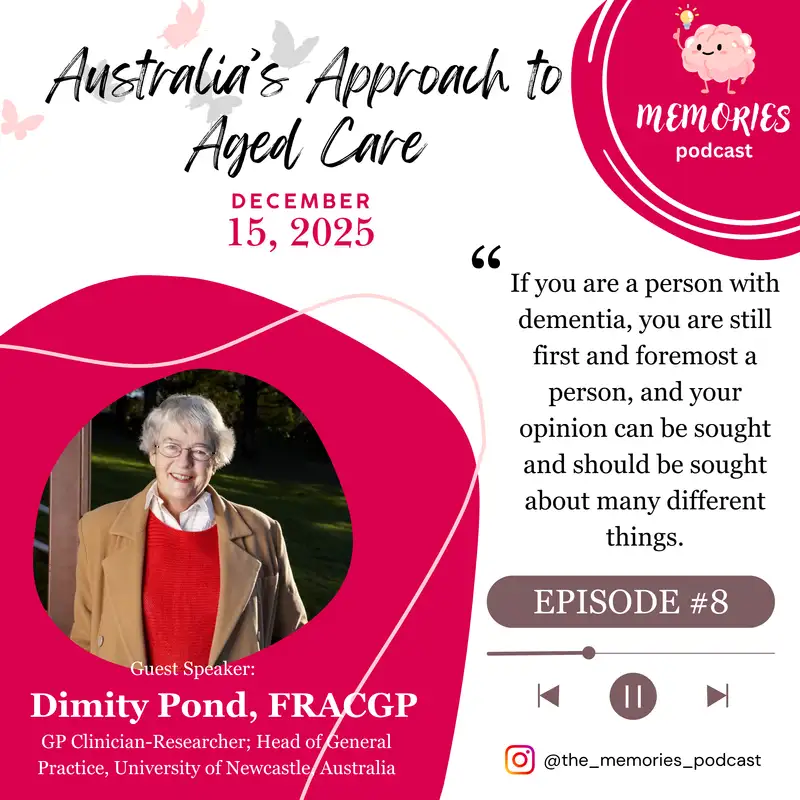
In today's episode, we have a very, very special guest. It's my honor to welcome Dr. Constance Dimity Pond, one of my dearest mentors from Australia. Dr. Pond is a general practitioner and has been practicing for over 40 years since 1984. Moreover, she is a clinical professor affiliated with the Wiking Dementia Research and Education Center at the University of Tasmania.
She's also the chair member of the research committee of the Royal Australian College of General Practitioners. Beyond this, she has a keen interest in aged care and dementia research and an incredible track record of research, where she has published over 200 papers in the peer-reviewed literature. Last but not least, she also served on numerous government advisory groups, including most recently the Minister's Dementia Advisory Group.
which advised the Commonwealth government in Australia It is truly a joy to have you here Dr. Pond I appreciate you so much for joining me. Before we dive in, it's nice to talk to you as well, ⁓ before we dive in, do you have any particular questions for me or anything you'd like to add before we get started?
Dimity Pond (01:58)
Thanks, Jackson. Nice to talk to you.
The name of the latest iteration of the government advisory group on dementia is the Dementia Expert Reference Group. So I probably gave you the name of the previous version, but this year it's the Dementia Expert Reference Group.
Jackson Nguyen (02:17)
dementia expert reference group.
⁓ I see
Gotcha.
Alright, thank you so much for letting me know. I guess first off, how are you doing today, Dr. Pond? Like what has been keeping you busy lately?
Dimity Pond (02:38)
⁓ Well, today, it's quite early in the morning, actually, but I've attended a morning session, a clinical session, with a group of GPs and trainee GPs and junior medical officers from the hospital about lung lesions. So we have a new system for screening for lung cancer in Australia. So it's quite a topic.
It's you.
Jackson Nguyen (03:01)
incredible. Take me back to the beginning, like in retrospect, like what inspired you to pursue a profession in general practice ⁓ and research in aged care and dementia.
Dimity Pond (03:12)
I really like being a GP. I like the breadth of general practice and I like the fact that you get to know your patients really well and their extended families and the context, the place where they live and so on. And all of these things of course affect their presentations and their diseases.
So I really like that being embedded as part of a community. And Aged Care, well, when I was a young GP, I put my name down to do a bit of work on a research project. And it was because I had a baby and I didn't want to work full-time in general practice at that stage.
And I, so it was a literature review to start with. And I could take the baby to the university library. Somehow or other she's grown up to be an academic, but I'm not saying that being six months old and being in a university library had an effect on that. There are probably a lot of effects. So, and so, and then that...
That was about sleep and the elderly. And then that moved on to me interviewing quite a lot of patients, over 100 patients living in a retirement village community about their sleep and other things and doing depression and dementia scales on them.
And that became an interest and I ended up starting a masters which turned into a PhD looking at dementia and depression in older people. And I heard so many wonderful stories and these people were amazing. And they'd lived through all sorts of ups and downs in their careers. And this was early on in my general practice career.
Some of them were survivors from World War II and had lived on small islands in the Pacific.
you know, looking after people almost single-handedly as nurses and so on. Amazing stories. And they welcomed me as someone to talk to them too. So that's why I became interested in aged care. Yeah.
Jackson Nguyen (05:20)
Yeah.
Yeah.
And I was wondering, could you elaborate briefly on a profession in general practice? I'm assuming it's similar to family medicine or primary care. What is your day-to-day entail as a general practitioner?
Dimity Pond (05:39)
Good.
So there are various ways in which GPs work in Australia. Some are probably closer to the model in the States and some a little bit different. But so I work in an outer urban region in New South Wales, not a rural region. So I don't have visiting rights to the local hospital.
If I was working as a rural GP, I would definitely be doing hospital rounds in the morning first thing. So I'm doing two days a week at the moment. so I turn up in the morning. As I drive into the suburb, which is quite close to my home, where the practice is, I notice who's walking their dog. Who's on the cricket or the...
oval playing sport and I may notice someone's car or something because I know all these people very well. And they, likewise, if I have a new car or even a higher car, I hear all about it from the patients during that morning. It's very personal.
and their opinion about the said vehicle. then I have patients booked in and they're booked in for face-to-face visits but we have a smattering of telehealth throughout the sessions and the standard booking is one
patient every 15 minutes but some patients, a lot of my older patients need half an hour so I have quite a few booked in for half an hour because they have multi-system disease and also they're a wee bit slower taking off clothes so I can check their heart or whatever and even just getting down to the room
takes them a little bit longer with their walker and so on. So that all contributes. And in Australia generally, 10 years ago the average time for a GP to see patient was about 13 minutes, but now it's about 19 minutes. So it's changed quite a lot. And I think this is about the changing demographic of our population.
Jackson Nguyen (07:46)
Hmm.
Yeah.
Dimity Pond (07:53)
So, but I also see babies and I also see sick children and I see adults. So I see probably more women than men, but I see ⁓ both. and of course the smattering of transgender and so on patients as well. So there's a big variety of patients. I really enjoy it.
Jackson Nguyen (07:58)
Mm-hmm.
Yeah. I see it.
Mm-hmm.
Yeah,
that's incredible. shifting gears a bit into the meaning of dementia, what does dementia personally mean to you, Dr. Pond, beyond the clinical manifestations?
Dimity Pond (08:30)
My mother did have dementia, so there is a personal story there. But when I see someone... So because I've been interested in dementia for so long and because I have patients that are quite long-term patients, I notice subtle changes as time goes through.
And I start to think, hmm, they missed the last appointment and hmm, they seem to have forgotten this medication and hmm, maybe they're not functioning quite as well as they were cognitively. And then we have a system in our practice of doing health assessments for people aged 75 and over. So the nurse will administer a cognitive function test and a depression scale.
And so then there's a workup for dementia and.
And it may take months or even years to get to the point of making a diagnosis or of getting assessed at the specialist clinic for dementia. Because there's quite a long, slow road round to dementia. And during those months or years,
Jackson Nguyen (09:35)
Yeah.
Dimity Pond (09:38)
I usually work with the patient and the family to start putting in supports for the patient. It may be medication supports, the medication in a handout pack so that they don't have to juggle 10 different bottles. It may be getting someone to help around the house. There are various programs for that in Australia. So it may be referring them for that.
Jackson Nguyen (09:57)
Yeah.
Dimity Pond (10:00)
It may be just talking to them about these issues because a lot of people don't really want to consider that they're getting older and I don't blame them. And they're fiercely independent and they don't want people to see the mess in the house and I don't blame them. So it can be quite a long process. And in Australia we worry about losing our driver's licence.
Jackson Nguyen (10:07)
Mm-hmm.
Yeah.
Hmm.
Dimity Pond (10:21)
especially in and out of urban area because public transport is not... not... there aren't frequent buses.
it's quite challenging, the public transport. So there's barriers to making that diagnosis. So it's a question of providing support, talking about it, talking about it, talking about it, more support, more support. How about going and seeing the people at the memory clinic? They might be a tablet or medication for this ⁓ and so on.
Jackson Nguyen (10:34)
Mm-hmm.
Mm-hmm.
Yeah.
And you know, because the term dementia itself can be a really heavy term, especially here in the United States, there's still that stigma regarding the terminology of dementia. because dementia is, you know, generally associated with loss, fading, especially with its depiction in the brain, ⁓ you know, with that tree with the like the leaves flying away, you know,
Dimity Pond (11:02)
Yeah, yeah. yeah.
Thank you.
Yeah.
Jackson Nguyen (11:17)
Although, yes, this depiction does resemble this idea of neurodegeneration and how some of your brain is progressively deteriorating, but how could this image or depiction contribute to this stigma overall?
Dimity Pond (11:18)
Yeah.
Yeah, I think that image is an unfortunate one, actually. It certainly does, I think, make things worse for people who get that diagnosis. I prefer to talk about memory and thinking problems rather than using the word dementia. ⁓ But of course, it's necessary to use that word.
Jackson Nguyen (11:45)
Yeah.
Dimity Pond (11:50)
to access some services and so on. And it's helpful for people and medications. And it's helpful for people to know and their families to know what their diagnosis is. So it's a bit of a two-way street. And I really think, I've read some articles about GPs in the UK not making the diagnosis until
there was a reason such as accessing a service and then they will make the diagnosis. So and then we might say well you know if you want to get some extra help around the house at the government discount rate we do need to put a diagnosis here and the one we would say it are because you fit the criteria is dementia. How do you feel about that? So
Jackson Nguyen (12:25)
Okay.
Dimity Pond (12:36)
So you link it to something positive. So that's the art of general practice. It's not all a science, it's about working with people too.
Jackson Nguyen (12:39)
Hmm.
For sure. And do you think Australia as a whole society is its view of aging and dementia? Has it improved or worsened over time?
Dimity Pond (12:56)
think people are a bit more open to it. Dementia Australia, which is the non-government organisation that does a lot of work in the area, it's done a lot of work at destigmatising dementia over the years with advertisements and so on. They've got an excellent helpline and they have events and so on.
Jackson Nguyen (13:04)
Yeah.
Dimity Pond (13:17)
But it's still stigmatised. It's still not something anyone wants to have. And there's big parts of our population that don't.
Jackson Nguyen (13:22)
for sure.
Dimity Pond (13:27)
get reached very well by messages about dementia. For example, non-English speaking background population. We've got a lot of migrants in Australia. In the big city I live in, which has got about four million people, a third of people have either come from overseas or have parents who come from overseas. So it's a relatively large amount of the population.
Jackson Nguyen (13:30)
Mm-hmm.
Mm-hmm.
Dimity Pond (13:49)
And course their parents are getting older and they may not speak English well. And their education about dementia may be...
They might not understand it as you talked about the brain deteriorating, but for some people it's got a spiritual meaning, not about the brain deteriorating. And that brings you into another whole field which is also very stigmatising. And might make them hide their person with dementia away and not let them, not let people see how they are.
Jackson Nguyen (14:07)
Mm-hmm.
Mm.
Dimity Pond (14:24)
And that puts a lot of weight onto the family care. So it's very difficult in some populations. And we have an indigenous population who get dementia early because they have high rates of risk factors such as diabetes. And they're also not very well-versed in brain deterioration.
Jackson Nguyen (14:31)
Yeah.
Mm-hmm.
Dimity Pond (14:46)
So health literacy can be not as great in that population. Of course we also have indigenous doctors, but across the board their understanding of dementia is probably less than other people.
Jackson Nguyen (14:57)
Yeah, for sure. I'm sure you have, you know, diagnosed patients with dementia. And so when you had to deliver this news to the patient, like, how did it make you feel inside? Like, what have you learned about communicating in a way with compassion without taking away that hope?
Dimity Pond (15:10)
⁓ yeah. Okay.
It's very hard.
So.
So one of the things I mentioned already is to link that diagnosis with then you will be able to get help around the house or then you will be able to get someone to do shopping for you.
It might be that...
Certainly the family carers are very keen to know the diagnosis more than the person themselves. It might be that... So I might start with these tests show that you have a memory and thinking problem. Would you like to know more?
and then they...
that puts them in the driver's seat about how much they want to know. And I will repeat that. you know, I will say, we use this diagnosis, you'll be able to get help from the aged care folk. And they go, no, no, no, no, no. And then three months later, they come in and say, you know, the hairdresser said to me, I
Jackson Nguyen (15:51)
Yeah
Dimity Pond (16:14)
get help with this diagnosis. And I said, yes, she was right. So having forgotten the no, no, no's, so then I can plug them into some help. ⁓ it's an iterative process. And I may refer them to the specialist. And the specialist says, you've got mild cognitive impairment, but it's not as bad as dementia.
Jackson Nguyen (16:18)
Yeah
Mm-hmm.
Dimity Pond (16:37)
And then it's, but they want to see me again in six months or 12 months. And so then, you know, I do venture on conversations about driving and so on because you've got cognitive impairment. So that helps to start that driving. What are you going to do? You know, nobody can drive for you. What are you going to do when you can't drive anymore?
Jackson Nguyen (16:49)
Yeah, for sure.
Dimity Pond (16:57)
And did you know there's community transport available? I was quite cheap too. You know, I'll give you the information but they never remember it the first time but later they will. So it's building on that relationship with the GP.
Jackson Nguyen (17:06)
I see.
Yeah.
because one of the most powerful lessons I've learned recently was I interviewed Dr. Beth Nolan here in the United States and she's the chief public health officer and lead speaker at this organization called Positive Approach to Care. And she was commenting how the process of diagnosing someone with dementia shouldn't. Sometimes it can make as if, you know,
their world is turning upside down and it's like all over from there. And it's, when a primary care physician says to a patient, here's your diagnosis and the patient asks the doctor, okay, what should I do now doc? Like Dr. Nolan, she was suggesting that the answer should like come as a form of a question. Well, what do you want to do? Cause like, do you want to travel? Do you want to be with your grandkids, et cetera? Cause it's ultimately, you know, trying to redefine.
⁓ what this new normality should be. Because a person with dementia, you know, they can still like live with meaning and purpose and still have that fulfilling life with that, like with a great quality of life in the long run.
Dimity Pond (18:14)
Yeah, I do sometimes say to people, even if you do end up getting this diagnosis, you're still a person. And I'll still ask for your opinion about things. You don't suddenly become a non-person because you've got this awful diagnosis. So, and ⁓ that's comforting, I think, for some people.
Jackson Nguyen (18:28)
Yeah.
Dimity Pond (18:34)
And it's really important to continue to talk to them as people and not to always talk to the carer, but to talk to them as well. and I went to the nursing home recently and my patient there with dementia is nonverbal now. She can't communicate. She was sitting in her chair and she didn't say anything. And I just chatted on and then...
Jackson Nguyen (18:41)
Yeah, for sure.
Dimity Pond (18:59)
She reached out, you know, to my jacket and I had a button. She pulled at this button and this button that she was pulling at wasn't this one, it was a different jacket. It was coming loose. And she went... And she was actually worried that I was going to lose this button because it needed to be reinforced. And she was making a caring gesture towards me.
Jackson Nguyen (19:14)
Yeah. ⁓
I see.
huh.
Dimity Pond (19:23)
even though she couldn't say anything. you know, it's, we must not underestimate what communication people can use and how they're feeling inside just because they've got dementia.
Jackson Nguyen (19:25)
Hmm.
Yeah.
Mm-hmm.
for sure.
Because communication can be not only verbally, but it can also be through the senses. And so we can communicate through our senses, whether it's the feeling of holding their hand or giving them a hug, or being by their side and stimulating their senses. That can be really powerful.
Dimity Pond (19:42)
Yeah.
Yeah,
I may have a cup of coffee with her while I'm there and just sort of chat on and she's actually, she needs help with drinking her coffee and so on. And she doesn't always answer me, but she's interacting to some extent and that's good.
Jackson Nguyen (19:59)
Yeah.
Uh-huh.
And of course, you know, each dementia patient ⁓ is different. And so, you know, they may have numerous emotions all at once, like denial, acceptance, overwhelm, et cetera. And how do you tailor your care approaches to best support those individuals and their families as they navigate the condition?
Dimity Pond (20:16)
Bye.
It's really tricky. I try and see them with their family care if possible.
especially as their dementia progresses and they need someone to bring them up to the surgery and by that time anyway and or the clinic whatever name you prefer and so then it's a question of having a bit of chat about how things are going and
Jackson Nguyen (20:53)
Okay.
Dimity Pond (20:54)
and reinforcing the positives. And I had a lovely chat with a mother and a daughter about showering. Do you need help with the showering? And the mother said, mmm. And the daughter said, ⁓ no, she's fine. Mom, you're fine. You can shower yourself, can't you? And...
Jackson Nguyen (21:11)
Thank
Dimity Pond (21:13)
I may have told you this story, Jackson, but for the purposes of the podcast.
And I said, okay, okay, so how does that work? And so the daughter said, well, you know, we go to the bathroom and I help mum get undressed because it's a bit hard. And then I turn on the shower because I don't want her to burn herself. And then I put the shower chair there and then I help her get seated in the shower chair. And then I put the liquid soap all over her. And then she showers herself. She grabs the shower.
Jackson Nguyen (21:39)
Yeah.
Dimity Pond (21:43)
hose and she puts all the water all over herself. It's fantastic, isn't it mum? And mum's going, yeah, yeah, I do it myself. I do it myself. And then I help her put the shower thing back, turn off the water, get her out of the shower, dry her and help her get dressed into a new clothes. And she showered herself. And if I had taken that at face value, I would not have understood how much time and effort the daughter was.
Jackson Nguyen (21:46)
Mm-hmm. ⁓
Yeah.
Mm-hmm.
Dimity Pond (22:10)
putting into that process. But nevertheless, it was a positive way of framing it for the mother. So trying to keep the conversation at that sort of level while getting factual information is quite good too.
Jackson Nguyen (22:26)
Yeah.
And shifting gears again to this concept of the difference between non-pharmaceutical versus pharmaceutical interventions in dementia care. And in one of my recent conversations with another expert, we discussed thoroughly about some of the potential dangerous usage of medications or the pill in managing symptoms associated with dementia. You know, a lot of times we can attribute
their insomnia, their agitation, depression, and other dementia associated behaviors to like these unmet needs that are either due to miscommunication, et cetera. And so sometimes, you know, doctors might just give the pill sort of like as a quick and temporary fix. And so I would love to hear your perspectives on this.
Dimity Pond (23:12)
So, I'll tell you a story. And this is a story about a residential facility for older people with dementia. And I know that where you are, Jackson, the same as where we are, there's a shortage of staff and funding for these because we have this big demographic shift and a lot of older people need that sort of care.
Jackson Nguyen (23:25)
Mm-hmm. Mm-hmm.
Yeah.
Dimity Pond (23:34)
And so in the facility I visit with the lady who showed me that my button was loose, when she first went there she used to cry quite a lot at night and the staff said to me,
Jackson Nguyen (23:44)
Mm-hmm.
Dimity Pond (23:54)
that's keeping the other residents awake and could you please give her a tablet for it? And I said, well, could we try some non-medication approaches first? And could you do a behavior chart and just chart things that you might do to help her feel better? And well, have a look. So they did that for a week, which was great.
Jackson Nguyen (24:14)
Yeah
Dimity Pond (24:14)
And what it showed was that five minutes with the patient every hour or two would stop her crying for another hour or two. And that was excellent. I said, that's so good. You guys are really good at comforting her. And they said, yes, but the thing is it goes on all night. And we've got very few staff at night. And we can't spend five minutes every hour or two.
Jackson Nguyen (24:22)
Wow.
Dimity Pond (24:40)
just with your patient when we've got 60 to look after. And only two staff members maybe. So in the end I did have to give her some medication. And now that she's more settled I'm reducing that. but still. it's difficult. There's a lot of factors that go into giving medication. Ideally...
Jackson Nguyen (24:46)
my god.
Mm-hmm.
Yeah.
Dimity Pond (25:02)
⁓ having more staff is the answer.
Jackson Nguyen (25:04)
Yeah,
for sure. And I think this problem with like, being understaffed, I feel like it's not going to get any better. I feel like it's only going to get worsened from there. And so like, I feel like as a society, it's kind of, it's important for us to kind of have to adapt to this new situation with short staff, because I feel like we're always going to be short staff regardless.
Dimity Pond (25:25)
Yeah, well, certainly in the foreseeable future, yes, as the population grows older. I mean, eventually it'll, don't know how, but that'll be decades away. Yes, so then there are other techniques like we had visitors from...
Jackson Nguyen (25:30)
Mm-hmm.
for sure.
Dimity Pond (25:49)
another dementia organisation called Dementia Support Australia. And they provided some iPads, and this patient's husband recorded himself talking to her. And she used that a little bit for a while until she lost the ability to turn it on. And they also have activities like painting and...
Jackson Nguyen (26:06)
Yeah.
Dimity Pond (26:12)
some other group activities for the people, sometimes dancing to music and so on. So, and that's helpful and that cheers people up a lot. So, there's a whole variety of approaches. And then her husband visits quite often and takes her out. And there's bus trips. So there's a whole variety of activities that kind of help. And that reduces the amount of medication needed. So.
So, and there are new guidelines for the medications which say please try these activities first and only, you know, if it doesn't work and if you can't manage. Then try the medication but for as short a time as possible. Review regularly. Reduce it as it becomes less needed.
Jackson Nguyen (26:52)
I see.
So the pharmaceutical, like the medications are only second line. First line is always these non-pharmaceutical.
Dimity Pond (26:57)
Yes. Yes.
Yes.
Jackson Nguyen (26:59)
And now moving on to I would love to learn more about you know the culture of dementia care in Australia and how it's different compared to other countries that you've engaged with for example the United States and Because in the United States we have you know nursing homes, but here in Australia. I know we have like aged care homes I'm sure that because with the different different terminology, but I
I'm wondering are these the same?
Dimity Pond (27:30)
think they're quite similar. It's a while since I've been to one of your facilities. More than a decade, I think. ⁓ And of course, there's a huge variety of those facilities. Some are small and dark and cramped, and others are beautiful. And the one I visited in your country was beautiful.
Jackson Nguyen (27:38)
Yeah.
Mm-hmm. Mm-hmm.
Dimity Pond (27:48)
with gardens and things where people could go out and so on. But, and we do have facilities like that here too in Australia, but it's difficult as dementia becomes more advanced to have people able to go out, so they may need to stay inside because they wander off and get lost. yeah. So,
Jackson Nguyen (28:03)
Mm-hmm.
Yeah.
for sure.
Dimity Pond (28:12)
And then the activities that get offered, I went to a facility in Ireland, a conference in Ireland, and they had a donkey in their facility. think donkeys at least used to be big in Ireland, and ⁓ not for riding on, but for petting. And I think the donkey was quite content, actually. ⁓
Jackson Nguyen (28:21)
Mm-hmm.
Wow.
that's lovely.
Yeah.
wow, so that was like a pet inside
the aged care home? Yeah, pet that.
Dimity Pond (28:37)
It was like a pet donkey. Yeah, yeah.
yeah, so there was a big grassy area in the middle and the facility had its units opening onto that and the donkey was there. so, and they had a beautiful, they also had a beautiful.
Jackson Nguyen (28:42)
Yeah.
Mm-hmm.
Dimity Pond (28:56)
China for tea, for people to have tea. And there was a shop where people would shop using credits, you know, that had been organized so they didn't have to count out money. So that was a really lovely facility.
So I haven't been to one like that here, but I believe there are some.
Jackson Nguyen (29:15)
And activity wise, like what are some of the activities that are offered for residents that live in these homes?
Dimity Pond (29:23)
Well, I think I mentioned painting. My resident gets covered in paint, painting and so on. The nurses sometimes suggest that she might need something before it so that she's not quite so active with the paint. I think that spoils it bit, so I'm not very keen on that. But it does make extra work for the nurses, cleaning her arms.
Jackson Nguyen (29:26)
Yeah.
Mm-hmm.
for sure.
Dimity Pond (29:45)
So, and there's certainly other things that I've seen in various facilities, bowls, bingo.
Cooking is really nice. People as a group, especially for the women, know, stirring up Christmas cake and that sort of thing this time of the year. And the smell of the cooking is lovely. So, yeah, so just everyday activities that people
Jackson Nguyen (29:53)
Mm-hmm. Mm-hmm.
Yeah.
Dimity Pond (30:14)
do but with some supervision that people are used to doing at home, they quite enjoy it. And the thing I know you're interested in is hand massage. Certainly at one of the facilities visited there was someone there doing hand massage with the patients with some scented oil and that was very soothing, the patients just loved it.
Jackson Nguyen (30:15)
Yeah, I see.
Yeah.
Uh-huh.
Yeah.
Dimity Pond (30:40)
So ⁓ yeah, so that touch, think older people in residential aged care are often quite short on touch, that's soothing, you know.
Jackson Nguyen (30:40)
Incredible.
You
Yeah, thank you Dr. Pond. I recently learned that in November 2024, the Australian Parliament, they passed like a new Age Care Act, which replaced the decades old Age Care Act in 1997. And so, you know, I think this act commenced like earlier this month actually in November, where it aims to like prioritize this person centered approach to dementia care.
putting the elders' rights and the needs first, as opposed to focusing more on the providers and the funding methods. And so this is, of course, a truly significant shift in how aged care is delivered in Australia, and it's awesome. How do you think this new act can revolutionize dementia care here in Australia?
Dimity Pond (31:39)
Yeah, so certainly the old act had got a bit...
difficult to negotiate. So for care at home.
Assessors would come and assess people on multiple different criteria and then calculate extra loadings for some of their packages and so on. So now with the new one, there's more of an overall assessment at the beginning. So.
Jackson Nguyen (32:03)
Yeah.
Dimity Pond (32:09)
There's been some teething problems, I think, with the algorithm that they're using. Perhaps the wrong demographic to be very, very wedded to computer algorithms. so I certainly have had carers of patients telling me that the assessor was pretty busy trying to
Jackson Nguyen (32:15)
Mm-hmm.
Yeah.
Dimity Pond (32:34)
down the things for the algorithm and that it got a bit...
said they got a bit cross about that. So I guess that's teething problems. I'm sure that'll get sorted out. So then the package that they get is they're supposed to be able to direct it themselves, but of course with dementia that would be their family carers directing how that package gets spent. that's...
Jackson Nguyen (32:41)
Mm-hmm.
Yeah.
Dimity Pond (32:58)
So once the algorithm has worked out how much money they are able to spend, then the family carer will work with a person with dementia to decide on how to spend it. So I think it's early days yet and we probably, as I say, a few teething problems to sort out and then it will be evaluated I think next year. So it would be interesting to see how that goes. Yeah.
Jackson Nguyen (33:03)
Mm-hmm.
Gotcha. Yeah.
Incredible.
And moving on to the GP research that you are involved with, I know a lot of the work you do aims to like translate the research into general practice. And I know you've contributed to the GP like red book of preventative activities around like age care and dementia.
Dimity Pond (33:41)
Yeah.
Jackson Nguyen (33:44)
I was wondering if you could describe to our audience what are some of these preventive activities and what do they entail?
Dimity Pond (33:49)
Yeah,
that's a great question. Thank you, Jackson. It's good to ask that question, especially for your audience. So, I'm actually involved in a couple of projects on preventive activities at the moment. So basically, it's good to start prevention early in life. So building up good brain reserve.
getting a good education is preventive in itself.
And then.
doing things that keep the blood circulating in your brain, exercise.
keeping blood pressure under control, having a good diet, ⁓ plenty of fish and fresh fruit and vegetables. There are a few different diets, Mediterranean and DASH diet that are good, but people can research their diet. Keeping body weight at a reasonable level, that's an ongoing challenge for me, but still I'm aware of it.
And then keeping good social connections. If you've got any sort of, I mean I wear spectacles, so these need to be checked at least annually. Because if I'm going to function well cognitively, I need to be able to see. And the same for hearing. And in fact, having more hearing increases your...
Jackson Nguyen (34:53)
Mm-hmm.
Yep. Yeah.
Dimity Pond (35:06)
chance of developing dementia. So it's worth identifying that. ⁓
Jackson Nguyen (35:10)
Wow. Yeah, and like wearing
a hearing aid to help with the hearing loss.
Dimity Pond (35:15)
Yes, I don't think it's completely proven that the hearing aid reverses that tendency, but it makes sense, doesn't it? it just hasn't been, you know, that long-term project. It hasn't been completely proven yet. And of course, as people get older, they don't notice that they're not hearing.
Jackson Nguyen (35:23)
Mm-hmm.
Dimity Pond (35:36)
and the people around them think they're just getting old and it might be wax. You know, they need to get their primary care nurse or doctor to have a look and get rid of that. It's easy to do. So, but we forget about it. So, and then there's also things like alcohol and smoking which can cause hardening of the arteries and that affects your ability to think clearly as well.
Jackson Nguyen (35:39)
is it.
Yeah.
Dimity Pond (36:00)
So there's quite a few things that people can do to at least stave off dementia, have it arrive later. And even if you do get a diagnosis of dementia, listeners, you can start on some of these things. And we've got guidelines actually for people with early dementia on guidelines on exercise.
Jackson Nguyen (36:03)
Yeah.
Dimity Pond (36:23)
And there's been quite good studies that show that exercise is helpful and will get your brain functioning better. Yeah.
Jackson Nguyen (36:23)
Yeah.
Yeah, are these guidelines?
Yeah.
Are these guidelines on like a website? ⁓ somewhere?
Dimity Pond (36:36)
I can send you a link. There's Australian ones, I'm sure there's ones in the States as well. But I think the Australian ones have got references so you could look them up. Yeah.
Jackson Nguyen (36:38)
Okay.
Yeah.
Yeah,
because as a community representative of the Alzheimer's Association, I give these awareness presentations and the Alzheimer's Association here in the United States, they also develop some of the guidelines to prevent it. How to best prevent dementia and by being proactive in taking care of your heart. Because a healthy heart...
translate to a healthy brain, know, like trying wearing a helmet because like with traumatic brain injury that could increase the risk of dementia, you know, good sleep, like eating healthy, like with the Mediterranean diet and such, like you mentioned.
Dimity Pond (37:15)
Thank you.
I am.
Okay.
And we've got someone at Dementia Australia is running a project in schools now to talk about protecting the head in sport, during sport. Because getting knocked out at sport on multiple occasions is not good for brain.
Jackson Nguyen (37:35)
Yeah.
For sure. Yeah. And as we start to wrap up in our amazing conversation today, if you could change one thing about how dementia care is approached in Australia, whether it's in policy, healthcare, or culture of care, what would it be?
Dimity Pond (38:05)
I would insert respect and dignity for the person with dementia. Respect for them and dignity, enabling them to be dignified. And that would include listening to what they have to say, including in research. I have people with dementia who've given me really, really good advice about research projects, even though they're living with dementia themselves.
And as a clinician, when talking to them, talk to them, not just to the care. And respect the fact that it could be us, it might be a while for you, Jackson, but it could be me sooner than you, who's actually a patient with dementia. And we want to be respected. And it might be that that also means...
Jackson Nguyen (38:46)
Yeah, for sure.
Dimity Pond (38:50)
encouraging dressing in the clothes that belong to your culture and having food that belongs to your culture, if possible, if you're in a residential facility. Respecting, you know, because it might be fine for an Australian person to wander around in what we call tracky decks, tracksuit bottoms and easy to put on tops, but if you're used to wearing a sari, that's not...
Jackson Nguyen (38:57)
Thank you.
Yeah.
Yeah.
Dimity Pond (39:15)
That's not right, it's not appropriate and it's sort of demeaning. So we really need to work on all of those things.
Jackson Nguyen (39:18)
Yeah.
For sure. I wholeheartedly agree with you on that. And my last question, if listeners today could remember just one takeaway from our conversation, what would you want it to be?
Dimity Pond (39:33)
I'm.
I think it would be what I say to my patients that if you are a person with dementia, you are still first and foremost a person and your opinion can be sought and should be sought about many different things. And the fact that you might not be able to manage a huge share portfolio or something like that is one thing, but it doesn't mean
that you can't even non-verbally identify that I've got a button that might fall off my jacket if I don't get it sorted out. And that is valuable contribution to me and a great communication from that person.
Jackson Nguyen (40:05)
Yeah.
Mm-hmm,
I see. But yeah, thank you so much, Dr. Pond. It has been such a pleasure to be with you today. Thank you so much for sharing your insights, your experience, and your empathy with us in today's episode. I appreciate you very much. Until next time, take care, everyone.
Dimity Pond (40:27)
Thanks Jackson. That was great. Thank you. Thanks for the opportunity.
Jackson Nguyen (40:29)
Thank you.