Jackson Nguyen (00:06)
Hi everyone, welcome to the Memories Podcast. I'm your host, Jackson Nguyen, and I'm a biochemistry senior at Worcester Polytechnic Institute in Worcester, Massachusetts. I am also a trained community representative of the Massachusetts chapter of the Alzheimer's Association. Memories is a podcast interview series that features in-depth one-on-one conversations with leading global experts across the globe to explore Alzheimer's disease and dementia,
from numerous lenses. Through these conversations, I hope to deepen public understanding of AD and share the voices of those making a difference across the globe. Memories is a personal passion project of mine where I hope to engage in fruitful conversations with experts to learn more about Alzheimer's and dementia and spread awareness of its devastating condition to my local and global community. Thank you so much for joining.
Jackson Nguyen (01:02)
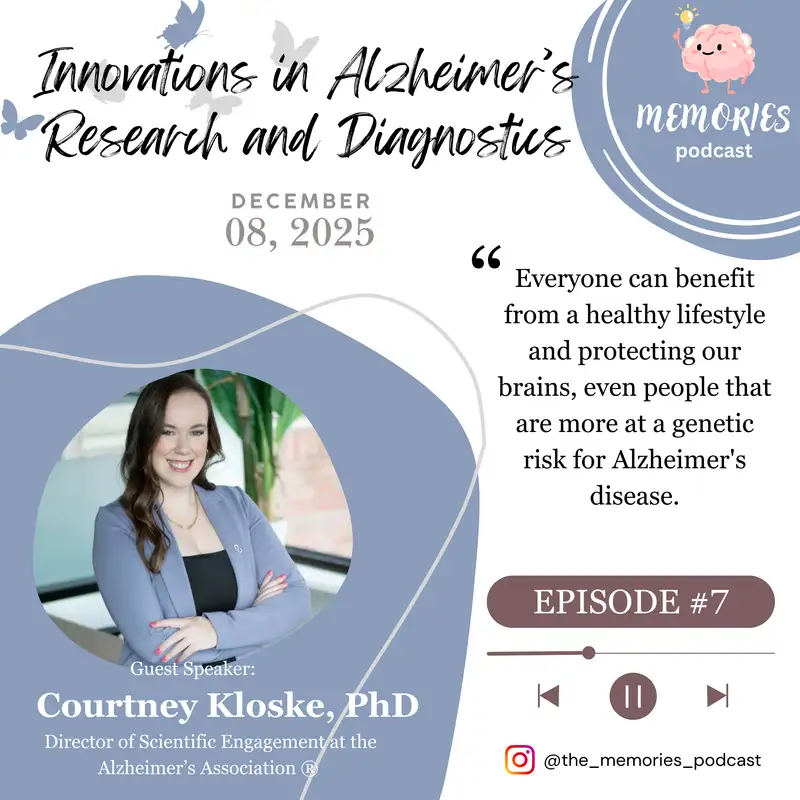
In today's episode, it's my utmost pleasure to welcome Dr. Courtney Kloske who is the Director of Scientific Engagement at the Alzheimer's Association. As part of her role, she drives efforts to accelerate the organization mission by creating and delivering outgoing research education and engages with all the association chapters across all states in the United States, where she informs staff and the public of scientific initiations.
and organization's key role to accelerate research to transform lives of those living with Alzheimer's and all other dementia. Prior to joining the association, she led independent translation research studies in AD focused on genetic risk factors, namely the APOE4 gene and their role in neuroinflammation. Dr. Kloske holds a PhD in physiology from the University of Kentucky and a bachelor's degree in and molecular biology from Auburn University.
It's remarkable to have you here, Dr. Kloske Thank you so much for joining me.
Courtney Kloske (02:01)
Thank you for having me.
Jackson Nguyen (02:01)
Before we,
thank you. And before we dive in, do you have any questions for me or anything you'd like to add before we get started?
Courtney Kloske (02:07)
No, just want to say it's a pleasure to be here and looking forward to this discussion.
Jackson Nguyen (02:10)
Thank you so much. First off, I wanted to ask, how are you doing today? What has been keeping you busy lately?
Courtney Kloske (02:16)
doing great. It's getting a little chilly in Chicago, minus the weather, doing really great. And one thing that's been keeping me busy is all of the advancements that we've seen in the latest research, which I know we're going to talk about today. But there are a few upcoming conferences that we will be sharing some new data about the FDA approved therapies for Alzheimer's disease. And so I'm, I'm busy with those presentations and making sure that the
the data that we're presenting is representative of the studies, which is great.
Jackson Nguyen (02:49)
Yes,
And can you take me to the beginning? Like what ultimately inspired you to pursue a profession to transform the lives of those living with Alzheimer's and all other dementias?
Courtney Kloske (02:59)
So I will take you all the way back to high school. I actually started ⁓ in science back in my freshman year of high school. I used to do science fair projects and went to the International Science Fair doing several of those projects. And one of them was specifically focused on Parkinson's disease because I had a family member that was impacted by Parkinson's and so wanted to study the disease and so I made a science fair project around that. And through that got really interesting.
in the brain more holistically. The brain is fascinating. And I knew going into college that I wanted to do research. So I did research at Auburn University, but I was looking at plants and I did not like plants. cannot keep one alive to save my life. So I knew plants were not for me. So then when I went to the University of Kentucky, I knew I wanted to go back to neuroscience, really looking at the brain.
and fell into an Alzheimer's disease lab. And it was being able to study Alzheimer's disease, meet people living with the disease, meet their caregivers and be able to talk about the latest science, share the hope in the field, but also hear their stories of living with dementia, especially now as we are in this new era of treatment. That is something that I started in back in high school with my research project and have continued to
go through into Alzheimer's disease research. It's been an incredible journey and the people that I've gotten to meet, they're so inspiring.
Jackson Nguyen (04:30)
Thank you, Dr. Kloske. And you have spent a significant time studying the APOE4 gene as part of your graduate work. In layman's term, could you explain to our audience what's the function of this gene and how it plays a role in increasing the risk of Alzheimer's?
Courtney Kloske (04:44)
Yep, so APOE4 is the largest genetic risk factor for Alzheimer's disease. So what that means is if somebody has a copy of
the gene is called APOE and, or the, yeah, the gene is APOE and there's various versions of it. So there's one that's APOE2, one that's APOE3, and one that's APOE4. And if you have the APOE4 version of this, that can increase your risk of developing Alzheimer's disease. It does not guarantee that if you have APOE4, you're gonna develop the disease, but it increases your likelihood of developing Alzheimer's disease.
does in normal functions is it takes cholesterol and lipids, like fats and really energy stores, it takes those and moves them throughout your body as well as in your brain. In the rest of your body it's made in your liver, but in your brain it's made by a variety of different cells helping to carry those important nutrients to help your brain function. And when you have ApoE4, that
it doesn't do it correctly. And so that is one of the issues with it. There's a whole other list of those problems that APOE4 can cause, but the main function that we understand is it helps with energy and metabolism.
Jackson Nguyen (05:59)
And if this gene passed down through genetics, like from your parents, you could potentially inherit that gene.
Courtney Kloske (06:05)
Yep, so you have two copies of APOE. One is going to come from your mom, one's going to come from your dad. And so if you may be 4-4, that means you got a 4 from both. But if you're, say, 3-4, you got a 3 from one and a 4 from the other.
Jackson Nguyen (06:20)
And how does this gene relate to neuroinflammation and how does it impact that inflammatory response in Alzheimer's?
Courtney Kloske (06:28)
So I mentioned that APOE does metabolism, and that's the main function of carrying those lipids around. But it impacts so many other areas of the brain that every time we study it, we find more things that it impacts, one of them being inflammation.
One thing that we have seen with APOE and inflammation is that in some cases there it could increase the level of inflammation, which, and sometimes in Alzheimer's disease you want some inflammation to potentially remove some of the brain changes, but you also don't always want inflammation. It's kind of like the rest of your body. You want it to do its job and then you want it to go away. And in some of the research it shows that APOE-4 doesn't have the normal
response to inflammation, to various stimulus, to various things in the brain and that can lead to increases in inflammation or decreases in inflammation. And so that's one of the areas that I was looking at.
Jackson Nguyen (07:24)
Gotcha. Next, I want to shift into like over the past decades, obviously we have made remarkable progress as a society to identify more biomarkers to treat Alzheimer's and all other dementias to aid in this diagnosis. For example, there's like an FDA approved blood test now that can help to detect these early stages, detecting for the presence of like these amyloid plaques, which are these like misfolded proteins.
who has shown to be increasing the risk of AD. There's like numerous other tests actively being developed. And so I'm wondering like how accessible are these tests right now to the general population?
Courtney Kloske (08:01)
So these blood tests, well, very exciting.
We still need more research behind them and we also need to be continuously informing both the public and clinicians when to use them and when they're appropriate to be used. And so right now really the blood tests that we have available should only be used for people that have cognitive problems. So say somebody comes into their clinician and says I'm having some memory concerns. They do some some general memory tests that show that they may have dementia. At that point,
these blood tests would be likely recommended to be used.
Right now, I don't know how accessible they are to the general population, but they are FDA approved. There are clinics that are using them in general practices. And so as we continue to have more research, to continue to inform more clinicians as to when to use them, how to use them, and how to understand the results, I think it will become even more accessible to the general population. But what's exciting about these blood tests is that
There will likely never be one test that will just decide if somebody has Alzheimer's disease or not. There's a whole battery of tests. This is one piece of that puzzle.
that could be a first level, that could be instead of having to do a PET scan in the future, maybe this is that first step to say, should they go take a more invasive test? Should they go do a PET scan? Should they do a CSF test? So in the future, this could be one of those easier first steps instead of doing the more invasive ones. But again, more research is needed and we need to continue to inform the clinicians as to how to use them.
Jackson Nguyen (09:16)
Mm.
Yeah, and certainly. And
because obviously there's like currently no cure to Alzheimer's and other forms of dementia, like what are some of the benefits of having this early diagnosis?
Courtney Kloske (09:53)
So an early and accurate diagnosis is really important for specifically if we're thinking about Alzheimer's disease. If somebody goes to their doctor with memory concerns early and they get an Alzheimer's disease diagnosis, meaning that their memory concerns are caused by the two hallmark brain changes, amyloid beta and tau tangles. They are more likely eligible for the new FDA approved therapies for Alzheimer's disease. Those treatments target the amyloid beta.
remove it from the brain and that has been shown to slow disease progression. But it only really works, it only works well in earliest stages of disease. So those earliest signs show the most benefit. So we're able to slow disease progression if people come to the clinic at those earliest signs, get that diagnosis and are able to start the therapy as early as possible. So that's one reason for a early diagnosis, but it also allows
people to have more time to plan for their future. Alzheimer's disease is a neurodegenerative disease. It does continue to progress and so it gives somebody the chance to make their own plans while they're still able to and have those conversations with their families. They're also able to, you can consider taking healthy lifestyle changes. So maybe it's eating healthier to protect your brain or exercising more to protect your brain. Those are things that you can start to do. Everyone should be doing
them now anyways, but it's something that you can start to do then as well. And participation in clinical trials. If somebody wants to participate in research, this is also a great opportunity that if they have that early diagnosis and they want to participate in research studies, maybe they don't have Alzheimer's disease. Maybe they have another form of dementia that we don't have FDA approved therapies for, but maybe there are clinical trials happening for that cause of dementia. They could go enroll in a clinical trial as well.
Jackson Nguyen (11:40)
Mm-hmm.
Courtney Kloske (11:46)
So there's a multitude of reasons to receive an early and accurate diagnosis.
Jackson Nguyen (11:50)
Thank you so much, Dr. Kloske. And next, I want to shift to the US Pointer study when I actually attended virtually the Alzheimer's Association International Conference this past summer. I was really stunned by all of the amazing results have come out so far. And I'm sure you're very familiar with this study, which is a two-year clinical trial to evaluate lifestyle interventions on risk of cognitive decline in diverse populations in the US.
and I'm wondering what surprised you the most about the results from this study.
Courtney Kloske (12:21)
So I remember sitting in the room somewhere. know you're watching on zoom, but I was sitting in the room and seeing the final results from the U S pointer study and seeing that regardless, and I'll back up a little bit. So the U S pointer study, like you already mentioned, it's a two year lifestyle intervention, but everyone that was enrolled in this study, which was over 2000 participants, they either followed a self guided healthy lifestyle plan, meaning that we gave them
the some materials on a healthy lifestyle, but it was kind of up to them to follow what a healthy lifestyle was. It was in the back of their minds as a more self-guided thing, but it was up to them.
The other side of this study was a more structured healthy lifestyle intervention with a lot of meetings, lot of tracking, a lot of follow-up, a lot of really hands-on implementation of these new healthy lifestyles. So we had both of those groups running in tandem. And so I remember seeing the results come up and it showed that both of those groups, so really thinking that regardless of if you're following this really structured group or not, that can show benefits to your brain.
So really thinking about that a healthy lifestyle in general is something that we should all be considering to help our brains.
But the most exciting part is obviously that the structured group showed an even more significant benefit from this intervention. So that really combining a healthy lifestyle of exercise, diet, social engagement, and keeping track of all of your health measures. All of those things combined can really help your brain. And it showed that the brains of those individuals are one to two years younger than somebody that wasn't following those
healthy lifestyles. And that's only a two-year intervention. Imagine if somebody's been following this for five plus years. That could be even bigger. So it is really exciting.
Jackson Nguyen (14:04)
you
Yeah.
And some of the lifestyle interventions include the mind diet, cognitive challenge through brain HQ, cognitive training, social activities, et cetera. I was wondering, could you tell us in depth about some of these lifestyle interventions and what do they entail?
Courtney Kloske (14:26)
Yep.
So one thing that I will direct all of your listeners back to is the Alzheimer's Association website, ALZ.org. We actually have the pointer recipe on our website. So you can go in and see exactly what this structured intervention looks like and understand what this recipe for a healthy lifestyle is based on the pointer study. But the MIND diet, that is a particular diet that's a variation of the Mediterranean diet. So it's really focused on dark leafy greens.
berries, healthy oils, healthy fats, all of the participants in that structured side of Poynter. They had a nutritionalist that they got to speak with and help make those dietary changes to their everyday life.
changing your diet is really hard. Everyone has probably gone through and decided, I'm going to start a new diet today. And in two days they've given up. And so one thing with the studies, we really wanted to make sure that they continue to follow it. And they made this mind diet part of their, their lifestyle was part of their habits. And so we gave them that hands on help because changing your diet is not easy. So mind diet was one of them. the brain HQ, they, they were asked to go on the brain HQ app for
I believe it was around 30 minutes every few days and just use and go through the surveys and the games and the other activities on Brain HQ really to keep their brain active. But it wasn't just cognitive challenging through the app. That's one thing that we can easily measure. But they also had other social activities and cognitive challenges like getting together with their pointer group. They were put into different groups and so they were able to get together and socialize.
That was one thing that they could do. Encouraging them to go watch webinars, listen to podcasts, read books, and really just having a more holistic social activities, cognitive challenges throughout their day-to-day life.
Jackson Nguyen (16:19)
And you know, the sample size, like you mentioned for this study is adults aged from 60 to 79. Because like brain changes for Alzheimer's and all other dementia, they may occur up to, you know, 20 years before symptoms start to rise. Where you're at this asymptomatic phase, is the association considering like performing a trial in testing the risk of cognitive decline in like middle-aged adults, like those in their 40s, let's say, who could potentially have some risk factors, but they don't know it yet.
say.
Courtney Kloske (16:48)
So part of the reason that this group was chosen is that they are the most likely to potentially develop cognitive changes in that time frame. So we wouldn't want to move to that 20 years earlier phase because it's likely not for another 20 years that they would even have those changes. And so the 60 to 79 was for that reason. And all of these people, none of them had cognitive impairment at the time of enrollment in Poynter.
Jackson Nguyen (17:08)
Yeah.
Courtney Kloske (17:17)
at risk of having cognitive impairment because maybe they had a poor diet or they had a poor, they weren't very healthy, they weren't exercising a lot. So everyone that was enrolled in the study could progress into mild cognitive impairment or dementia within that two year study, but they weren't yet on that trajectory yet.
As we continue to analyze the data, we may see that some of the participants had amyloid beta in their brain already as we're starting to do some additional analyses on the brain scans and some other things. But the people that were enrolled was really that cognition is what we were looking at if they had cognitive impairment or not.
As far as looking even before symptoms occur, there are some clinical trials going on right now that are looking at testing individuals that have amyloid beta and tau building up in their brains. No cognitive impairment with the anti-amyloid therapies. So thinking, preventing the cognitive symptoms from even occurring in these groups. so those studies are ongoing. So really going to that 10 to 20 years before symptoms, those studies are much longer.
We're hoping to hear results from those in the next couple years as we think about moving even earlier in disease.
Jackson Nguyen (18:30)
Yeah.
And lifestyle interventions, you know, they tap into this realm of preventive neurology, which is a field that I'm considering in pursuing this field, like where individuals, know, they take actionable and practical steps to help reduce their risk of these numerous neurological disorders and prevent them. And which of these lifestyle interventions like resonate with you the most? And do you do some of these interventions to take care of your brain as well?
Courtney Kloske (18:56)
So this is a question that I get in many of my presentations of like, well, what do you do to help your brain? And also, what should I start doing today? And for me, one of the...
powerful parts of Pointer is this is really combining a lot of different aspects of our day to day life. So this is combining multiple features of both your diet and your exercise and just engagement in your communities. But one thing that I always tell people is don't necessarily start all of those things today. If you start making a million lifestyle changes in one go, you're going to give up and you're not going to stick to it. And so I really think making small and actionable changes are really important.
And so for me, one of those was to start going to a workout class two times a week in the morning before work. That I started to love and I was like, wow, now I'm more energized when I get to work, even though I was up an hour and a half before I wanted to be up, but I was more energized. And so I continued to add to that. And so that's one example of starting small and continuing to build out, really thinking about exercise, but with that thinking about diet and also staying engaged with my community.
So for me, one of those would be the exercise feature, but recognizing that it fits into that larger picture.
Jackson Nguyen (20:12)
Yeah.
And with the advancements in science and technology, research is now more important than ever. Like, ⁓ how is the Alzheimer's Association, in addition to the US pointer study, you know, contributing to advancing research in other realms of Alzheimer's and all the other dimensions?
Courtney Kloske (20:28)
So the Alzheimer's Association is the largest nonprofit funder of Alzheimer's Dementia Research. We are currently investing $460 billion, million dollars, million with an ⁓ in dementia research. That is across 1,200 projects in 56 countries. So we really have a large reach with all of the funding that we are able to support around the world. U.S. Pointer Study, we're continuing to invest in that. We invested, I believe it was over $30
Jackson Nguyen (20:40)
Yeah.
Wow.
Courtney Kloske (20:58)
million dollars in the first part of Poynter that got us to where we are now and we're committing an additional 40 million dollars to continue expanding Poynter. So not only are we expanding Poynter, but we are also supporting all other types of research from basic science to clinical trials to care and support research. We're really doing it all in funding those researchers around the globe to continue advancing the science.
Jackson Nguyen (21:04)
Mm-hmm.
remarkable.
Courtney Kloske (21:27)
you
Jackson Nguyen (21:28)
Yeah. And this is a fun question, but like if you were to have a billion dollars to fund research that would go towards Alzheimer's and dementia, which areas of research would you want your investment to go into? Like which areas of Alzheimer's are we still lacking in knowledge? And it's the most worthy of having the answers right now.
Courtney Kloske (21:45)
Well, we already started off with my favorite area of dementia research, which is genetics and APOE4 specifically and inflammation. And so if I was given money to be able to do something crazy, I think that's where it would go is focused on more of this.
personalized and precision medicine approach to dementia research. So not only looking at the biomarkers that somebody has, but also considering genetics and saying, maybe this, once we have multiple therapies approved, maybe this combination would work best for this person, or maybe this combination would work better for them. And so that is where I see the future going, is a precision personalized medicine approach for Alzheimer's dementia research.
And
we need more understanding and more research to get us there. There are many areas that...
we need more information for. That is something that we're never gonna have all of the information. We're never gonna have all of the answers when it comes to Alzheimer's C's and other dementias. But I think one area that we really need to focus on, especially in clinical trials, is making sure that they, whatever clinical trial we're running, represents the population that we're studying. And that's something that in Poynter was really important. We had over 2,000 people enrolled, but 33 %
of them were from groups that were historically underrepresented in clinical trials. Mainly because we knew that we wanted to be able to say whatever came out of Poynter was applicable to the entire U.S. population. We didn't want to just say it was for this, we only studied this one group so it's really only going to be beneficial for them. We wanted to make sure that we could build it out and support everyone. And I think that's something that's really important for all future clinical trials as we continue to
Jackson Nguyen (23:21)
huh.
Courtney Kloske (23:32)
have new therapies on them, go through the ⁓ clinical trial pipeline. Just need to make sure that they are appropriate for everyone and that they were part of a clinical trial.
Jackson Nguyen (23:42)
Yeah. Although we still lack a cure to Alzheimer's and all other dementias, I'm wondering what gives you hope that we'll be able to find a cure one day and Alzheimer's and all other dementias? Like what do you envision that day will look like?
Courtney Kloske (23:57)
So I think it really starts early. So I think that when we're thinking about, especially the pointer results, that if all of us are considering a healthy lifestyle as early as possible and start making those lifestyle changes.
that's gonna reduce the risk of dementia. It's not gonna necessarily prevent it. Some of the healthiest people that I know have developed Alzheimer's disease. But we're doing what we can to reduce our risk. So I think that's something that's really powerful that everyone can consider. But then I think for something, on the other side of it is how many clinical trials that are currently in the pipeline. We keep adding more and more every day, targeting different areas.
of the disease. We've started with amyloid beta. That is just one piece of this massive puzzle.
But as we continue moving forward, we will start having more puzzle pieces filled in. We may have treatments that target tau, and those would be applicable to other forms of dementia. We may have ones that target Lewy bodies, which is another form of dementia. And so I think as we continue to build out from the basic science all the way up to a clinical trial, having more of a lot of different puzzle pieces that we can give to people and support them in their journey.
Jackson Nguyen (25:09)
Thank you, Dr. Kloske. And as we start to wrap up, I like to ask this to all my guests, but if you could change one thing about how Alzheimer's or dementia care is approached today, whether it's in policy, healthcare, or the culture of our care, what would you want it to be?
Courtney Kloske (25:25)
That is a ⁓ big question. think coming from me as a from the research side, because I'm not a
Yes, I have a doctor in front of my name, but I am a PhD. And so I, not in the healthcare space, not in the policy space, and I have never been a caregiver. But from the researcher, from the research aspect, one thing that really excites me for the future is going back to those clinical trials and making sure that everyone is aware as to that there are opportunities to participate in research. If they're interested in that, they can give back to
to
give back to the clinical community by participating in that research and also that the Alzheimer's Association is always there to support and provide answers. So say you've heard about the new therapies for Alzheimer's disease but have no idea what they mean, the Alzheimer's Association is there to help answer your questions from the basic science all the way up to those care and support avenues. And so I think one thing that I would love is that if everyone knew the Alzheimer's Association
know many people do, but I think that the number of resources that we have, just want to make sure that everyone is able to access them during their disease journey through every stage. are here for them.
Jackson Nguyen (26:38)
.
Thank so much for sharing that, Dr. Kloske. And if listeners could remember just one takeaway from this entire conversation today, what would you want it to be?
Courtney Kloske (26:50)
So I think we've hit on quite a few things and I...
We've talked about genetics and we've talked about healthy lifestyle. And I think for me, one takeaway from this conversation is that everyone can benefit from really thinking about a healthy lifestyle and protecting our brains, even people that are more at a genetic risk for Alzheimer's disease. So say you have a family history, go ahead and start thinking about what you can do to help your brain today. I think that that's something that's really important. And again, you can go to our website and learn
about that pointer recipe and how to start implementing it into your day-to-day life.
Jackson Nguyen (27:28)
Thank you so much, Dr. Kloske And I'm wondering what's next for you in 2026. Is there something you're excited for that's coming up?
Courtney Kloske (27:34)
So actually, I guess it's the end of 2025, but the clinical trials and Alzheimer's disease conference is happening in a couple weeks. And I am excited to hear more results from the US pointer, as well as some other clinical trials that we anticipate reporting out at that conference. So I think over the next couple months, we will see even more progress in the dementia space and really looking forward to hearing those results and seeing what's next.
Jackson Nguyen (27:43)
Mm-hmm.
Thank you so much, Dr. Kloske It's been such a pleasure to be with you today. Thank you so much for sharing all your insights, your experiences, and your empathy with us in today's episode. I appreciate you very much. Until next time, take care, everyone.