Jackson Nguyen (00:06)
Hi everyone, welcome to the Memories Podcast. I'm your host, Jackson Nguyen, and I'm a biochemistry senior at Worcester Polytechnic Institute in Worcester, Massachusetts. I am also a trained community representative of the Massachusetts chapter of the Alzheimer's Association. Memories is a podcast interview series that features in-depth one-on-one conversations with leading global experts across the globe to explore Alzheimer's disease and dementia,
from numerous lenses. Through these conversations, I hope to deepen public understanding of AD and share the voices of those making a difference across the globe. Memories is a personal passion project of mine where I hope to engage in fruitful conversations with experts to learn more about Alzheimer's and dementia and spread awareness of its devastating condition to my local and global community. Thank you so much for joining.
Jackson Nguyen (01:01)
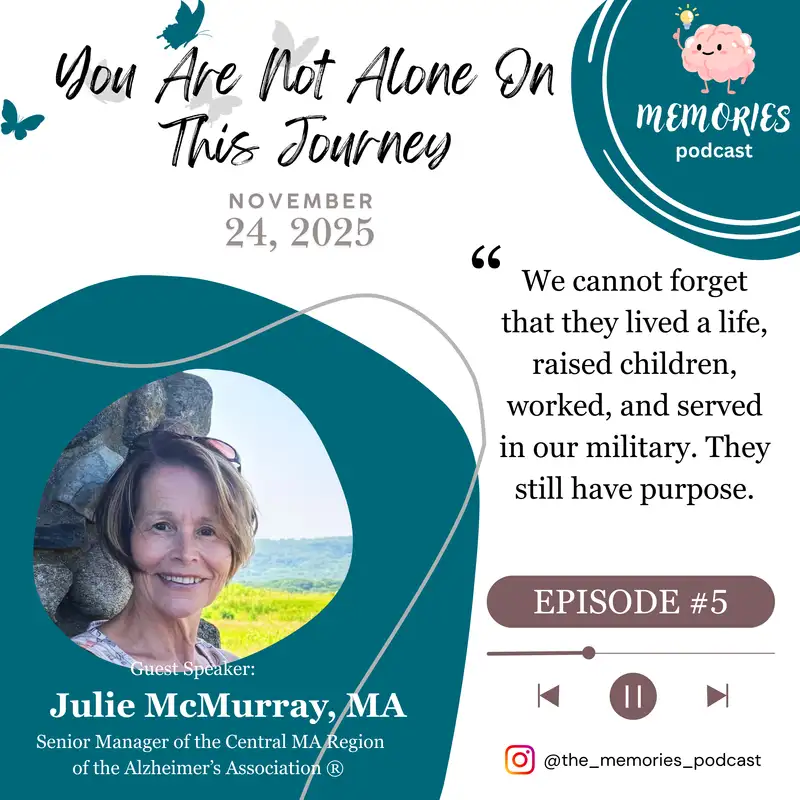
In today's episode, it's my remarkable honor to welcome Julie McMurray, who is currently a senior manager of the Central Massachusetts Region and Community Outreach of the Alzheimer's Association, for 23 years. She facilitates training and educational programs for family caregivers, those with Alzheimer's and dementia and professional caregivers. She also oversees program volunteers in Central Mass.
that helped to extend the reach of the Alzheimer's Association through awareness, education, and support. She holds a Master of Arts focus in counseling psychology from Oakland University, as well as certifications in mental health counseling, social work, and dementia practice. Thank you so much for joining me.
Julie McMurray (01:41)
Thank you so much, Jackson. I really appreciate this opportunity.
Jackson Nguyen (01:45)
And before we dive in, do you have any particular questions for me or anything you'd like to add before we get started?
Julie McMurray (01:51)
Yes, I would. So I just want to thank you for being a trained community representative, which is a volunteer for the local office in Worcester, Massachusetts. And you are helping me extend the reach.
of the Alzheimer's Association and really boots on the ground by attending health fairs and offering some of our Alzheimer's awareness presentations. So I am grateful to you, Jackson, for not only doing this podcast, but also helping to create awareness and being a volunteer. So thanks.
Jackson Nguyen (02:31)
Thank you so much, Julie. I really appreciate all those words. So I guess to begin, how are you doing today, Julie? What has kept you busy lately?
Julie McMurray (02:38)
you
Well, Jackson, I am doing just great. Thank you so much for asking. And I think what's really kept me busy is just being out in the community, trying to reach individuals that may be concerned about themselves as they're aging and maybe some memory concerns, but also trying to connect with families and caregivers that may be struggling to really understand
the resources that are available in the community as well as trained professionals. I really enjoy being in front of an audience that are out there providing care to individuals living with Alzheimer's and really giving them the best practices.
Jackson Nguyen (03:23)
Incredible. Take me back to when you first entered the field of Alzheimer's and dementia care. What ultimately inspired you to pursue this profession? Was there like a specific light bulb moment that signified this?
Julie McMurray (03:35)
Yeah, so, you know, I think selfishly. It's because I didn't grow up with grandparents. I lost my grandmother when I was five years old. And so I think I was naturally drawn to working with seniors. And early in my career, I worked for Tri-Valley, one of the aging access service points based in Southwestern
County
and I just found so much joy visiting individuals that were living in the community that needed some really basic resources like Meals on Wheels and maybe a homemaker, homemaker to keep them safe in their home. And I just always left there feeling very fulfilled. And that really just, I think, opened my eyes to the possibilities of
furthering my career specifically in Alzheimer's and dementia.
Jackson Nguyen (04:31)
Hmm.
Next, I'd love to start by, you know, grounding our audience into what Alzheimer's really means. Like of course Alzheimer's is just one of the 200 many possible causes of dementia as it's dementia. like an umbrella term that with Alzheimer's being the most prevalent causes. so to be as inclusive as possible for those with other forms of dementia, like Lewy body and vascular dementia, would use the word dementia here on out, but in your own words, Julie, like beyond the clinical manifest,
of dementia, what does dementia personally mean to you?
Julie McMurray (05:05)
Yeah, so I think, you know, dementia isn't normal aging. And I think, you know, as we all get older, I think it's really common to say, you know, my mom's, you know, getting forgetful. And I think I'm constantly reminded that, you know, we're all aging and it is okay to forget certain things. But when you're seeing a loved one
I'm really struggling with those day-to-day activities.
that really signifies that there is something going on. know, what could it be? Maybe it is a form of dementia, as you mentioned, but is it something that just we need to do more diagnostic workups to determine what could be going on for this individual? So I just think it's really beyond normal aging and just think creating awareness about
educating people that yeah it's really important to you're seeing something start talking about it and at least have a conversation with the primary care physician.
Jackson Nguyen (06:16)
I'd love if you could elaborate a little bit more on like how is normal aging different than dementia.
Julie McMurray (06:22)
Yeah.
So, you know, the way I look at it and really to simplify it, you know, as I mentioned, as we get older, we all forget. And I always give this this example as you go into a room, you know, maybe you want to grab your sweater and you get into the room.
and you stand there and you go, what did I come up here for? And then you leave the room and all of sudden you remember, okay, I wanted to grab my sweater. And that's really part of normal aging or you misplace an item like your cell phone and you're really able to retrace your steps to find that, your cell phone.
And we think about the world we're in right now. We're inundated with information, whether it be through news channels, and we're balancing so much, we're multitasking. And so yeah, on occasion it's normal to forget something. But the good thing is with normal aging you remember. With dementia, you tend not to remember, or you ask the same question over and
over again. And that's really a cause for concern.
Jackson Nguyen (07:40)
I know the Alzheimer's Association, have published some of these, 10 warning signs that families could possibly look for. And some of the signs that you mentioned earlier is like forgetfulness and occasionally, you know, memory loss and disruption to your daily activities and such. Would that be some of these warning signs?
Julie McMurray (07:57)
Yeah, so we developed like 10 warning signs. And these really are the symptoms of dementia, right? And as you mentioned that dementia is the umbrella category. And then there are many types of diseases that can cause these dementia symptoms. So yes, memory loss that disrupts daily life, challenges with planning and solving problems, difficulty completing familiar tasks.
Confusion, not remembering the date, the month, the year. Trouble with understanding visual and relationships. This happens because our vision is part of our brain and people might start getting into fender benders, right? Because they're not being, have the ability to judge distances. Poor judgment, you know, on a really cold day, someone's not wearing
appropriate clothing. Another one could be withdrawal. This disease causes people to start isolating and they don't want to engage or interact. But having those warning signs...
You don't have to have all of them, right? It could be one, two, maybe three that's significant for that person. So I always advise when I speak with families, anybody that's concerned that if you're just noticing some of those signs, again, having a conversation with the primary care physician to really talk about what could be causing these signs.
Again, Alzheimer's is the most common form of dementia, but yes, there's other types of dementia too. Lewy body, frontal temporal dementia, vascular dementia.
Jackson Nguyen (09:44)
because I personally feel like, it's normal. for people to have what's called mixed dementia nowadays, where it's not just because some of the symptoms they could overlap and, like it's more prevalent, I feel like for people to have mixed dementia where, know, like potentially some hallucinations, which is one of the symptoms that's associated with,
like vascular dementia or like gluey body that normal, you know, like Alzheimer's wouldn't have. And so.
Julie McMurray (10:06)
Mm-hmm. Mm-hmm.
Yeah, and as you mentioned, the mixed dementia, typically when we see mixed dementias, there are more cases of the Alzheimer's and the vascular dementia.
Jackson Nguyen (10:25)
And I wanted to ask, like, besides aging, which I know it's one of the primary risk factor to Alzheimer's and dementia, but what are some of the other risk factors?
Julie McMurray (10:36)
Yeah, so as you mentioned, aging, know, and what are we all doing? We're living a lot longer than we ever have before. We have found cures and treatments and preventatives for diseases that people used to die from, right? So we're living longer. But the other risk factors include family history. If you have a parent
with some form of dementia or they have passed from dementia or a sibling, another blood relative, that does put you at greater risk for developing the disease. And then certainly genetics. We have identified genes through research that can put a person at greater risk.
for developing the genes. It's not a guarantee.
And so those are considered risk genes like ⁓ APOE-E4. But there are some deterministic genes that if a parent has passed that gene down to you that yes, you will develop Alzheimer's. Although it is relatively rare, there are people living with younger onset Alzheimer's that can occur before the age of 65.
Jackson Nguyen (11:51)
Thank you, Julie. And of course, you know, the word like Alzheimer's and dementia itself can definitely feel very heavy. And so if let's say a patient were to be diagnosed with dementia or like, or like any forms of dementia, can turn their world upside down in a way where, because I feel like as a society, we, there is some stigma to dementia where
once you get diagnosed, it's like, you you get isolated into this sort of bubble in a way. And for those who might fear getting a diagnosis, what would you say to their fear?
Julie McMurray (12:26)
And you know what, it is scary.
you know there is still a stigma despite the fact that there is you know an estimated seven million Americans living with you know Alzheimer's here in Massachusetts you know over 135,000 individuals are living with Alzheimer's so you know we know given the national statistics there's 11 million caregivers and it's unfortunately that there's still that stigma but
We also know with early diagnosis people can feel very empowered
Because there are better treatments that not only help the symptoms but can have now shown to slow the progression in the earlier stages. It also allows the individual to really have input on, you know, planning for their future. You know, there is not a timeline for someone to live with the disease. You know, typically it's eight to ten years, but in the earliest stages a person can
put their financial and legal affairs in place. They can have discussions with their loved ones on, you know,
what they want their care to look like, right? It also can allow them to maybe do the things that, you know, they were putting off, right? Enjoy meaningful activities with their family. But it also can help those families really tap into the resources that are available. Certainly through the Alzheimer's Association, we have resources that can help the
but also the individual as well.
And I also just wanna point out too that just because you might be showing some signs and symptoms of dementia, like going through the diagnostic process, it may not be Alzheimer's at all, right? So it could be something else, a urinary tract infection, a thyroid condition, could be a drug interaction. So having that conversation and starting the process,
it may not be a type of dementia. And so I think that's really one of the best reasons to just have the conversation and certainly as I mentioned the benefits about early planning and putting things in place can be empowering for the individual.
Jackson Nguyen (14:51)
And how could potentially prolonging this diagnosis potentially exacerbate the problem further?
Julie McMurray (14:57)
Yeah, well, as I mentioned, just with some of the treatments, right? Most recently in the last couple of years, we have two medications that have shown in clinical research that have shown to slow the progression in those individuals living in the early stages. So how incredible is that? That it can really allow a person
It's not going to cure the disease, but it can allow the person to maybe live in the early stages longer and have a more fulfilled life. And certainly, having a good team of doctors is really beneficial because they can educate the family on what resources are out there that can benefit the individual, but also other things like
like
just taking care of their brain. We know through our research that staying active really at any age, but certainly a person that's living with Alzheimer's can help maintain their brain, eating well, getting a good night's sleep. having, you know, not only the treatments available, but also the things that we can control ourselves can really allow a person
to do, you know, live well with the disease. And I also find through my work, Jackson, that a lot of people that are diagnosed in the early stages become huge advocates for us. They go in front of our legislators, our senators, our congressmen to talk about the needs for accelerating research so that we have better treatments and more treatments. And, you know, they
are the voices?
of our, you know, living with Alzheimer's and it's through them, those individuals that we learn so much and I have had the privilege of meeting those individuals and talking to them and I think some people are very amazed that, you know, that they still, they have that ability to use their voice and we really emphasize that, you know, and we want them to connect with us.
because hearing it from a person living with it is very, very powerful.
Jackson Nguyen (17:14)
Thank you so much, Julie Like you said, although we do not currently have a cure to this devastating condition, including Alzheimer's and other forms of dementia, when that day do happen, what do you envision it will look like and how far are we from that day?
Julie McMurray (17:30)
So I will tell you Jackson that when I entered this field 30 years ago, you know, we didn't have.
many, we didn't have any really treatments. Really the best treatment came along I believe in the early 90s, right? And it really was to treat the symptoms. And so we have made significant strides for treatments that not only treat the symptoms but now also slow the progression. But what's very exciting is that research has shown us that people can live
and are probably living 10 to 20 years with some of those biological hallmarks. And if we can treat those hallmarks before the onset of symptoms, then we will eradicate this disease. But what I look forward to most is seeing people live longer, happier lives.
⁓ with decreased emotional and financial burdens that this disease causes.
and that it's really gonna cut down on the stresses to our healthcare system. I think about people that have lived well into their 80s and to their 90s and have had very fulfilled lives and that because of their age, just because they've lived long.
they are at greater risk. So I do think we will have a cure or a means of prevention in my lifetime and I will be able to shut my office door and you know say we did it and it will be probably the best day of my life because I've been impacted by this disease personally and I have worked with so many
families that have struggled and tried to navigate everything that there is to know about Alzheimer's. So I will just I will feel very happy.
Jackson Nguyen (19:29)
Likewise, Julie, I am very hopeful for that day as well. I am very optimistic that in our lifetime, hopefully in the next 10, 20 years, we'll be able to find a cure to this condition. And next I want to move on to the caregiving side of dementia. And in terms of our current culture of care,
to care for elders with dementia in our society, what do you think we are doing well on? And what are some areas that you think we could potentially improve?
Julie McMurray (20:00)
So, you know, I think we could really approve upon, you know, overall training for, you know, staff that are providing hands-on care to individuals, whether it be community-based settings or in, you know,
facility-based settings.
you know, some of the just the person encouraging the person's centered approach to care, meaning being in the moment with that person and maximizing what they can do to minimize what they can do. But also I think physician education is still something that is needed. I think we are getting better.
But I've heard too many families say that, you know, in trying to advocate for their parent, that the physician said, well, they're getting old. Or what do you expect, right? And so...
When you're dealing with a disease like Alzheimer's or another form of dementia and there is no cure, I think we're doing a disservice to those individuals, to those families, because that might be a barrier for them to get a diagnosis, but also access the services that are out there. And I am constantly reminded that we have wonderful services, not even just through the
Alzheimer's Association, but just in our local communities that families aren't aware of. So I think it's kind of a general challenge, but I just think ongoing like just training and we're learning more every single day and then making sure that people that are providing care
also know what are the best practices.
Jackson Nguyen (21:55)
Thank you, Julie. And to elaborate on what you mentioned earlier, because as a patient care assistant myself
when I read some of the clinic notes of patients and sometimes, you know, physicians, can be really broad. They still use the word, you know, dementia as, and they don't really, because dementia, like an umbrella term. They don't even specify, you know, whether it's vascular or whether it's fluid body or whether it's Alzheimer's. And it's like, I agree with you that like additional training would be really sufficient.
Julie McMurray (22:10)
Yeah.
Right.
Yeah, and you know what, it's interesting that you bring that up, Jackson, because, you know, when I meet a family and they say, my mom has dementia, I'll say, well, you know, what type? They say, well, it's not Alzheimer's, it's just dementia. And I go.
Okay, so I think it's you know, there are many different types of dementia and so I just am reminded that yes, like physicians need to do their due diligence because treatments might be different depending upon the different forms of dementia, you know, certainly the symptoms can be different and you can empower families through education on you know, maybe what's coming down the road.
as far as providing care. So yes, I echo what your experience has been.
Jackson Nguyen (23:15)
for caregivers that are out there, like what are some of the communication strategies that you would recommend to best connect with those living with dementia such as Alzheimer's?
Julie McMurray (23:27)
So there are typically two forms of dementia that most of us are aware of and that's like our verbal communication, but it's also our nonverbal. And our nonverbal is really what...
is we use the most, right? So it's our body language, it's our tone of voice, it's those facial expressions. And somebody living with Alzheimer's may not...
really understand what you're saying to them using words but they can sense how you're feeling and usually they will respond in a similar way so if they can tell that you're stressed or that you're angry even though you're saying kind loving words they might react in a similar way
So I think caregivers, families, professionals need to really understand and be very aware of what their body language is saying.
And I also think that I entered this field at a time where we still did reality orientation, where we would remind them of what day it was, what month it was, what year it was. We try to pull them back to our reality. And what we have learned is that
We need to enter their reality and we need to be with them where they're at. And as a person progresses through the disease, the moment is what's most important and to create moments of joy, moments of meaningful engagement.
And that could be singing. It could be pet therapy. It could be looking at photos. And also I think what this disease is, if there is a gift that gives in this disease, it's our long-term memories. And person that might not know the here and now,
Jackson Nguyen (25:27)
Mm-hmm.
Julie McMurray (25:31)
But they can tell us about their life and tell us about their childhood and some of those memories that were really powerful for them. And it can create such a beautiful moment in the here and now. And I do think that whether you're a professional, caregiver,
you know, family member, I think we have to just remember that we can't rationalize, we can't explain things because that can become very, very frustrating. Just be present in that moment.
Jackson Nguyen (26:10)
I love how you use the term the here and the now because that reminds me of this really famous meditation monk like Thich Nhat Hanh who he used that terminology in the here being present in the here and now is so important to be mindful, especially in a world where, you know, we're so busy and in the hustle and bustle of life sometimes.
like in the nursing home, we're under staff most of the times. And so if in a facility we have 40 residents and there's, you know, like maybe 10 staff, not all the residents can be attended to
the residents, in the dementia nursing unit, sometimes they can be left alone for a few hours. No one's there to talk to them. And, you know, and so they're under-stimulated. And so that's why a lot of my research is focused on this aspect of like sensory stimulation and how in those with dementia, like because of this...
under sensory stimulation. It's important that we find new risk modalities to try to stimulate these senses, whether it's the hearing, whether it's the vision, whether it's through music and such like that. And that can be really powerful. But most importantly is the staff being present there to facilitate some of these activities. And it's that human connection that all matters.
Julie McMurray (27:28)
Yeah, and the five senses, as you mentioned, are so incredibly powerful, and it's a way that we can still connect with an individual through touch, through this stimulation. And so yeah, it's, I think, something that, again, we don't always think of, but it can be extremely beneficial, but also very simple, right, if we just take the time.
Jackson Nguyen (27:53)
The time is key being there with them. Sometimes we don't really honestly need to do any really, you know, crazy activity. Just being there with them in that moment and just having a good conversation, being there. And sometimes that's all they need. It's just that human connection. Yeah.
Julie McMurray (28:09)
Yeah, and I absolutely,
holding their hand, sitting next to them and standing instead of standing over them, combing their hair.
Like when I worked in assisted living, there was this one woman and she was not very verbal. And we struggled with how can we connect with her. And we found that just combing her hair really resulted in her being very calm. She'd always have a smile on her face.
and you know we would communicate that with the different shifts. So if they knew that she got agitated or maybe just you know it was something to do when a staff member had five minutes it was a gift for the staff. It really made their jobs easier but also for that individual.
Jackson Nguyen (29:05)
And what is the most beautiful interaction or act of humanity that you have witnessed in dementia care?
Julie McMurray (29:11)
Jackson.
So I think, and this is broad, but I think that...
just recognizing that no matter where the person is on this journey.
that they still have purpose.
and that they were, know, before their diagnosis, they lived a life. They raised children maybe. They worked. They served in our military. They volunteered in their community. And we cannot forget that.
and that they had interests, and that what I may like is very different than what somebody else liked, and that not everybody is going to like to play bingo, right? But I will share this example.
When I worked in a nursing home, we were fortunate to have clergy from different churches come to do services and
I'd say, let's gather these residents to come to service. And some of the staff say, well, she's not Catholic. And I said, it's OK. It's OK. And it was amazing, that sense of community and that.
Jackson Nguyen (30:42)
Mm-hmm.
Julie McMurray (30:43)
even though she wasn't Catholic, she knew all the prayers, she was able to sing the songs and I think it was just very amazing to the staff and I just said you know what it's about building that sense of community that everybody is welcome, right?
Jackson Nguyen (30:50)
Yeah.
Julie McMurray (31:02)
Yes, we also took her, you know, we also took a resident that wasn't, you know, that went to the Catholic service, but we also, you know, we took them to their own services, you know, whether it be, you know, a congregational service, but I just think it was very eye-opening that, again, we don't want to put people in little boxes. And so, yeah, that just always kind of stayed with me.
That, yeah, it's just we want to build that sense of community and that sense of welcome
Yeah, I know. I guess I'm getting emotional thinking about it.
Jackson Nguyen (31:40)
Yeah, thank you so much, Julie, for your perspectives. Next, I want to shift gears a bit into a really exciting study that the Alzheimer's Association has published recently, the US Pointer Study.
because one of my favorite schematics from the association is actually this 10 healthy habits for the brain, including, you know, like healthy diet, sleep, managing blood pressure, staying in school, challenging your mind, et cetera. And so in relation to this US Pointer study, which is a two-year clinical trial that have shown that some of these healthy behaviors have really remarkable impact on our brain health and may help reduce cognitive decline.
And with these healthy habits, know, they theoretically they sound amazing, but how do you best carry them out in practice?
Julie McMurray (32:27)
Yeah, and I think people have to be really aware that, you know,
You know, you can't do everything, right? We might have some limitations, but can we implement a few healthy habits? I'm a strong believer that we can do this at any age, right? So whether it be moving, any type of movement is good. It could be a chair exercise. It could be, you know, walking. It could be using the stairs versus using an elevator. You know,
eating healthy, maybe incorporating some vegetables now and again, or fruits, right? Cutting back on sugar, maybe cutting back on that nightly candy bar, you know? Also just...
thinking about protecting your brain, wearing a helmet. Yeah, maybe it's not cool to wear your helmet, but we know that any type of traumatic injury to the brain can lead to dementia down the road. I think also getting sleep, and I think, Jackson, you and I have talked about this, sleep is difficult. ⁓
Jackson Nguyen (33:40)
Yeah.
Julie McMurray (33:41)
And I know
for you and for me, but turning our screens off before we go to bed, maybe just reading, trying to do some activity that unwinds your body so that when you go to bed, you get a restful sleep.
you know, not relying on medications to sleep because that might have some other side effects. Stop smoking. We've always heard that smoking is not good for us. You know, it's not good for our brains.
Staying social. I am a huge fan of senior centers, of memory cafes, of people that go to the gym just to like connect. I walk with friends every Saturday morning and it's just a huge, like not only it's physically good for us, but we're also being social, right? And then cognitive engagement. We can all learn something new. And I think through your podcast,
Cass Jackson people have learned a lot, which is good for our brains. But just thinking about maybe picking up Monjon or chess or maybe Scrabble, crossword puzzles. Those are things that we can do to really benefit our brain, right? And then just always being aware of our numbers, our blood pressure, our blood sugars, our cholesterol, keeping those
and check can protect our cardiovascular health and we know there's a correlation between heart health and brain health. And so I think, you know, we don't want you to go out and run a marathon, but start simple, start small, and I think you can incorporate...
by taking small steps. And yeah, we just realized that through this pointer study that, you know, it's not all doom and gloom that yes, these are risk factors that we have some control over, which is really like, you know, really helpful to all of us.
Jackson Nguyen (35:48)
Thank you, Julie. And to zoom out a bit into the work that we do here at the Alzheimer's Association, with dementia cases rising globally, why does the work that we do here matter now more than ever?
Julie McMurray (36:01)
Yeah, so at the Alzheimer's Association, we have so many levers. I'm part of our care and support lever, again, creating awareness in the community. But we also have advocacy lever, which raises awareness about the impact of the disease on our communities.
our healthcare system, on our underserved communities, as well as all the work that we do at the Alzheimer's Association is free of charge and we can't...
We can't do the work that is so necessarily and I can't do the work that I do without our, you know, our fundraising lever where we do fundraise to support our free programs and services, but also to raise funds for research. You know, really what we've learned about the disease process has really
occurred in the last decade. so, you know, there are more, there's more research in the pipeline and, you know, we're learning more every single day. And so all the work that we do, I think, is extremely important. And just to highlight, you know,
The role that the programs and services team and the care and support team is that, you know, our 24-hour helpline that's really, you know, is the gateway to accessing all of our programs and services that's available 24 hours a day. That's in 200 languages. And so, you know, in the education programs, know, Jackson, the ones that you do in the community, the ones that I do.
and my other volunteers that helped to provide information. we know knowledge is power. And if people have the most up-to-date information, know the resources, they can be in a better position to not only help themselves, but the person they're caring for. And just...
the support groups that we provide to caregivers and care partners. And we can do our education programs, our support groups, not only in communities, but also virtually that can really help to connect with other individuals that wouldn't necessarily be able to get to a community support
So I think the work, I think the work can be daunting, it can be challenging, but as I've always said, like there is a lot of hope and I will continue to do the work that I do until, you know, yeah, we create a world without Alzheimer's. And as you know, Jackson, you know,
There's so much being done here in the United States as far as research, but also globally, right? And what we're learning, and if there's a cure, a means of prevention, a treatment, it's gonna benefit everybody.
Jackson Nguyen (39:26)
Yeah, thank you so much, Julie. And if our audience today wants to get involved in the Alzheimer's Association and contribute to making a difference in the lives of their communities, how could they get started?
Julie McMurray (39:38)
Yeah, so there's a lot of opportunities for getting involved. if you have an interest in helping to educate individuals or maybe facilitate a support group, you can reach out to our local Mass New Hampshire chapter or even through our 24-hour 7 helpline.
I am one person here in Central Mass, but I rely on volunteers to really connect with families and just...
constituents in our communities to educate them and give them ways to help their loved one, but also facilitate the support groups that are so vital to families. So if you're interested in being a community representative like Jackson and help us do some education programs and staff or health fairs, like please, that's wonderful, or a
community educator.
to do some more of our in-depth education programs, but also support, we would love to bring you on board. We offer a lot of support to our volunteers, but there's also, if you want to participate in one of our fundraisers, our largest fundraiser is the Walk to End Alzheimer's, which is held throughout the United States. Locally, we have a Worcester County Walk to End Alzheimer's.
that happened just on October 19th and all the monies raised do support our programs and services but also raise funds. But there's other we have Ride to End Alzheimer's, we have Do What You Love which is a fundraiser that people just choose to do what they love and raise funds as well as
ride to end Alzheimer's. So there's definitely ways to get involved and we would love to have you on board with us and we will certainly if you have any questions you can reach out via our helpline or our Massachusetts New Hampshire chapter of the Alzheimer's Association that's based in Newton but we have offices in Worcester as well in Manchester, New Hampshire.
Jackson Nguyen (41:55)
Thank you so much, Julie, for sharing all of these remarkable resources for our listeners today. And as we start to wrap up, if you could change one thing how Alzheimer's or dementia care is approached today, whether it's in policy, healthcare, or culture of care, what would it be?
Julie McMurray (42:13)
So, you know, I guess I just wish that there wasn't still that stigma. And, you know, we talked about there shouldn't be a stigma, knowing that there's over, you know, seven million Americans living with this disease. And I'll give an example. Like, I go to health fairs and wellness fairs, and people avoid my table.
you know, and they're like, I'm not there yet. And I'll say, it's okay, like just come and get some information on maybe ways we can help or ways that you can be involved. that's something that I notice. I don't think it's as bad as it used to be because I do, think we're...
because of our more effective treatments that, you know, there is hope. And so, yeah, so then, you know, people are a little bit more willing to, I guess, talk to me.
But again, as I mentioned, I would love that we really prioritize care for individuals living with Alzheimer's, whether it be in the community setting, the clinical setting, or in a facility-based setting, and really just to recognize that they are still
you know, individuals that have, you know, led a life and they are still very much purpose in their lives and we can help.
promote that and that you know the only ones that can take away a person's dignity is us. They aren't able to take away their dignity. We do that by the way that we talk to them and communicate with them, the way that we treat them. And I think it's just really an important reminder for everybody.
Jackson Nguyen (44:12)
And if listeners could remember just one takeaway from this entire conversation, what would you want it to be?
Julie McMurray (44:18)
Can I say two things, Jackson?
Jackson Nguyen (44:20)
You absolutely can.
Julie McMurray (44:20)
Okay,
so I think it's important just to remember that, and this is something I learned very early on in my career, is that if you've met one person with Alzheimer's, you've met one person with Alzheimer's. Not everyone experiences it the same way because of how complex and complicated our brains are. And that the other thing which
be is that we want listeners to know that you are not alone on this journey and we want families, individuals that may be a concerned or have been diagnosed
and even professionals to connect with the Alzheimer's Association. The helpline again is incredibly beneficial and sometimes families call us or an individual calls and they don't know what to ask. We will listen to them and we will help guide them and connect them to the resources that they will benefit from. And I just say, know, make that phone
and that you will see that there is an organization that really focuses on care and support and really creating a world without Alzheimer's. But until we get there, we want to be a resource.
for everyone that's impacted by this disease.
Jackson Nguyen (45:51)
Thank you, Julie. And my final question is, what's next for you in 2026? What's something that you're excited for that's coming up?
Julie McMurray (45:59)
there's so many things. I really think that as an organization, we are again with our initiatives around research.
and what we're learning in research, about the blood tests, about other treatments that are in the pipeline.
that again could help to slow the progression. Again, it's very exciting for me given the longevity I've had in this career in the field of Alzheimer's and dementia. And I think one of the things that I enjoy most is really just connecting with families and
So
again, people that are concerned and I always feel like I am really kind of bridging that gap of people feeling isolated and alone to then feeling very...
like hopeful when they do connect with the Alzheimer's Association. And so I do just really look forward to continuing to be out there in the community, Jackson, and you know when we've done things together, like, you know.
There is that light bulb moment when people are like, you do that? There's a helpline? And I go, those are the things that I truly do enjoy and that make me feel like I have, like what I'm doing is valuable. And so I think I want to continue to do that just to connect with more people.
Jackson Nguyen (47:39)
Thank you, Julie. Well, it has been such a pleasure and honor to be with you today. Thank you so much for sharing your beautiful insights, experience, and empathy with all of us in today's episode. I appreciate you very much, Julie, for all your mentorship and my time working at the Alzheimer's Association. And I look forward to continuing to work with you in the years to come. But yeah, until next time, take care, everyone.
Julie McMurray (48:04)
Thanks, Jackson.