Jackson Nguyen (00:05)
Hi everyone, welcome to the Memories Podcast. I'm your host, Jackson Nguyen, and I'm a biochemistry senior at Worcester Polytechnic Institute in Worcester, Massachusetts. I am also a trained community representative of the Massachusetts chapter of the Alzheimer's Association. Memories is a podcast interview series that features in-depth one-on-one conversations with leading global experts across the globe to explore Alzheimer's disease and dementia, from numerous lenses. Through these conversations, I hope to deepen public understanding of AD and share the voices of those making a difference across the globe. Memories is a personal passion project of mine where I hope to engage in fruitful conversations with experts to learn more about Alzheimer's and dementia and spread awareness of its devastating condition to my local and global community. Thank you so much for joining.
Jackson Nguyen (01:02)
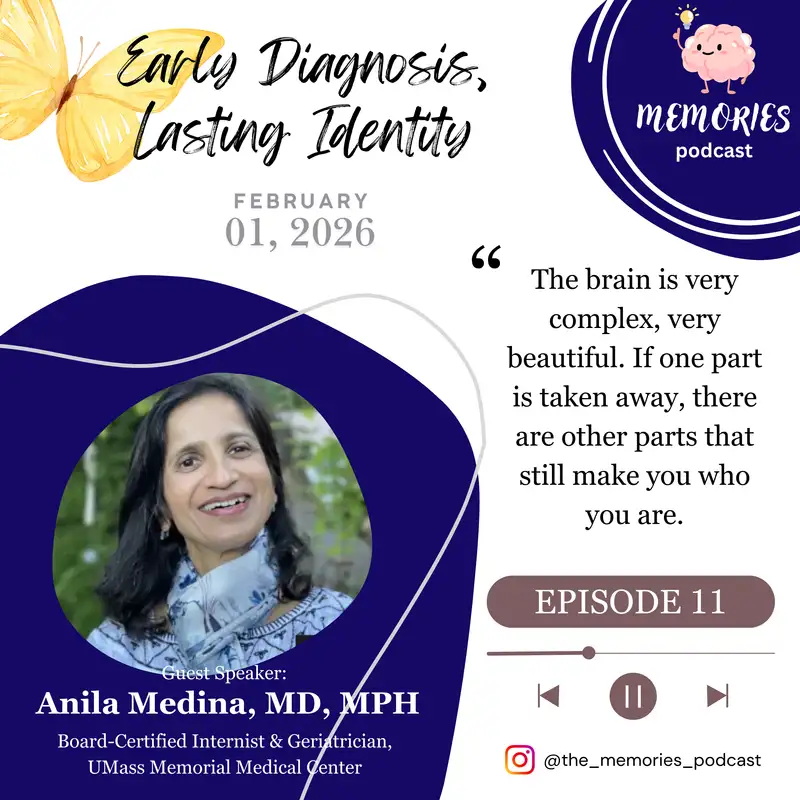
In today's episode, I'm delighted to welcome Dr. Anila Medina, who's a board certified internist and geriatrician interested in comprehensive dementia care. She's an assistant professor in the Department of Medicine, Division of Geriatric Medicine at UMass Chan Medical School. She attended medical school at Dow University of Health Sciences in Karachi, Pakistan, after she obtained a master's in public health in epidemiology.
from the University of Massachusetts Amherst. For more than a decade, she worked as a primary care physician, a leader in population health, an educator, and a mentor to students and trainees. To improve on her knowledge of aging population and dementia care, she completed a fellowship in geriatric medicine from UMass Chan Medical School a few years ago. She currently works in the Division of Geriatric Medicine at UMass and has established an interdisciplinary cognitive
clinic along with the Department in Neurology as part of her vision of developing a comprehensive multidisciplinary memory center of excellence at UMass Memorial Medical Center. Dr. Medina has also founded a multi-specialty interdisciplinary aging brain and mind initiative at UMass with geriatric medicine, neurology, neuropsychology, geriatric psychiatry, and palliative care.
She's on the Medical and Scientific Advisory Board of the Alzheimer's Association of Massachusetts and New Hampshire chapter. She also serves on the committee at the American Geriatric Society for Clinical Practice and Models of Care. She's the course director for fourth year medical student elective in geriatric medicine and third year student clerkship director in population and community health. It's truly a pleasure to have you here, Dr. Medina.
Anila Z Medina (02:42)
Thank you for having me here, Jackson. It's my honor to be here with you.
Jackson Nguyen (02:47)
my pleasure as well and before we get started do you have any questions for me or anything that you'd like to add
Anila Z Medina (02:52)
No? No. I think I'm good.
Jackson Nguyen (02:54)
Excellent. And I guess to begin, how are you doing today, Dr. Medina? What has been keeping you busy recently?
Anila Z Medina (03:01)
I am doing very well. We are in Boston, Massachusetts. So we had lots of snow, so staying warm and inside for the last couple of days.
Jackson Nguyen (03:12)
Yeah, I see. And I would love if you could take me back to the very beginning of your profession. What ultimately inspired you to pursue a career as a physician where you can care for others, specifically, know, elderly populations with dementia?
Anila Z Medina (03:29)
Yeah, so, you know, I think if I go back to where I grew up in Karachi, Pakistan, there were a few professions that people would decide on going. It's not how we have here in the United States that you can choose, you know, many, pathways. So if you were doing, you know, doing science subjects,
you were either going into a profession of medicine or engineering. And I chose medicine at that time because I was interested in the healthcare and taking care of people and all that. But I would say my anchor was when I entered medical school in Karachi and this was a hospital which was run by the government and to see what
was going on were some of the other private hospitals and the difference that we could do for a lot more patients. So we started a patient welfare association in the hospital to be able to take care of these patients who were not able to take care of themselves, couldn't afford medications, couldn't afford to take care of their families if they were sick. And so that's what led me to pursue physical, you know.
the profession as I did and also wanted to enhance my studies coming to the United States. Going into this Master's Public Health gave me this a little bit of a different perspective on taking care of patients as also a population health too.
Jackson Nguyen (05:03)
That's so powerful. Thank you so much for sharing Dr. Medina. And to root our audience into the meanings of dementia, which is the core of your work, what does dementia personally mean to you, Dr. Medina, beyond the clinical manifestations?
Anila Z Medina (05:20)
Yeah, think dementia, what dementia means to me is what makes you you. And I think that, you know, it takes the core of being who you are as a human being is what the dementia diagnosis takes away from that person. You know, personally, my mother-in-law has Alzheimer's disease and even, you know, with her wonderful sense of humor and
able to engage in conversations, even philosophical conversation, that is who she is. That is what makes who she is. But how it has, you for the last 10 years taken away that core of who she was when I, you know, have known her now for 30 years. And that is what dementia takes away from you. And for patients and families,
I think if we understand as professionals is to provide them or learn from them as to what makes them, them is important. And that's what dementia is for me.
Jackson Nguyen (06:24)
Yeah, because I feel like dementia is often, you know, when we think of the word dementia, people always perceive it as some sort of decline, some sort of loss. And do you think that's the right conception of where we should really? Because dementia, you know, it carries a lot of stigma. Do you think our perception in terms of that loss and decline contributes to this stigma?
Anila Z Medina (06:45)
I completely agree with you is because there is so much stigma and not just in one population or others, it's throughout the world. You will see that. That is why it's super important to come up with a diagnosis as best as you can, as close to as possible, and also educating people and families and caregivers as to what actually dementia is because sometimes people think dementia equals.
Alzheimer's disease, which is, as you know, is probably not true. Yes, it is the most common cause of dementia. But what actually dementia is, is as you know, it's a clinical syndrome of symptoms that have taken away that ability of taking care of yourselves in daily activities of living. And that is what defines dementia. And then you differentiate it from other things in that in that manner is there is something called mild cognitive impairment and
earlier than that is subjective cognitive decline. And then earlier than that is something what we consider as normal aging. So I think defining that helps people understand and hoping that'll take care of the stigma of dementia. I mean, there's a lot of talk about changing the terminologies, whether to call it dementia or to call it major neurocognitive disorder is another field of
you know, where this trajectory is going in terms of the naming process. But yes, I think the more you provide people with testings and diagnosis is helpful for patients and families. That is what I'm saying.
Jackson Nguyen (08:19)
Yeah,
I completely agree with you because the terminology can be really important because dementia there's are over, you know, 200 different causes of dementia with, you know, Alzheimer's being like the most prevalent, think making up like 60 % of the cases. And so I feel like a lot of people, you know, they use Alzheimer's and dementia interchangeably. And, know, when we, ⁓ because Alzheimer's, you know, takes the center stage. And so
because that could potentially leave others who might have Lewy body dementia or vascular dementia feeling sort of like left out. And so we focus our attention on Alzheimer's, but there's other so many different types of dementia that's important to be taking into consideration as well.
Anila Z Medina (09:01)
Absolutely, I completely agree with you is because there is, when patients are coming to you as a professional trying to figure out what's going on with their loved ones, I think it's very, very important to come up as close to providing a diagnosis and also some help in trying to figure out the causes of dementia.
as close as possible, as best as possible. I think providing that information is helpful for families to go through the process of progression and all that. like you said, when you give them a diagnosis of Alzheimer's disease, yes, there is a progression, but then there are other factors like depression or other vascular stuff like diabetes or cholesterol, and providing them with the improvement of brain health.
with taking care of their sleep, taking care of their hearing and their vision and socializing and taking care of their hobbies. You how important all of that is also for brain health. I think there's more of education process that you need to do and that's what we try to do in our clinics too.
Jackson Nguyen (10:08)
Yeah, thank you, Dr. Medina. And in your opinion, in your years working as a physician here in the United States, like do you think the existing culture of dementia has gotten better or has gotten like worse
Anila Z Medina (10:21)
So I can't answer the question in terms of what the culture is happening, but I think there is more awareness now, I would say. Especially, I would say, in the last few years, now that some of the other disease-modifying treatments are coming out, especially for Alzheimer's disease, people want to know what's going on versus considering it.
you know, every time as, okay, you know, people are getting older, so they're developing some memory changes or thinking or language changes, and it's just part of normal aging and just kind of taking care of their families like that. So I feel like there's more awareness, and I think that is helpful for us providing that information as best as possible, as early as possible, so that we can help these patients. And I do think that this will also
go into other countries if we consider this as a global public health problem as we age or as people will be aging in the next 20, 30 years.
Jackson Nguyen (11:21)
Absolutely. And you know for those who might fear getting a diagnosis, you know, can you know, I feel like their world might turn upside down. And so if you would have to say something to those people, like what would you say to their fear?
Anila Z Medina (11:35)
So I am a very positive person and I try to bring as much positivity to any diagnosis, regardless of what it is. But I do explain to people, you the brain is very complex, very beautiful. And, you know, if one part is taken away, there are other parts that are still functioning and still make them who they are. And I'm coming back to that original
thing is, you know, what makes them who they are is important for patients and families to understand. like you mentioned, you know, there's a loss that they're feeling by, you know, that memory change or thinking or language. But I do give them as much as possible in their belt for them to take it as a positive thing, along with, you know, the treatment options and the resources and the support services we can provide. But I do.
leave them with some positivity because there's a lot of emotion that comes on with this diagnosis and a lot of emotion that comes on with what is more to come in the years to come. And so people are already afraid and worried about. But if you give them some tools and some education and some options as to what is it that you can do to keep this going, I think it's super helpful.
Jackson Nguyen (12:56)
Yeah, and you know, like each dementia patient can be different and they may have, you new risks, know, emotions at all at once, sort of like denial, acceptance, like being overwhelmed. And I'm curious, like how do you tailor your care approaches as a physician to like support each of these individuals and their families as they navigate the condition?
Anila Z Medina (13:17)
Yeah, so what we are trying to do also in our clinics is to have sort of this, you know, like the vision is to have as comprehensive as possible. you know, let's say when they're coming in for the first time, and like you said, know, every individual, every family is different and they bring the symptoms, the diagnosis, very, very differently and they approach it very differently. So when they're coming in, you know, for the first time, obviously we try to do as much.
get as much information, do as much testing with, we have a psychometrist to do the testing, you know, in a manner that is not, takes too much time, but enough time to get as much information as possible. Then I'm a geriatrician who works in the cognitive clinic and we have a neuropsychiatrist, we have a nurse practitioner who does, you know, some of the care planning and stuff. So when they're coming in, you know,
Like you said, know, some patients have lack of insight even though they're having these problems. Some patients when they're coming in early stages, they know there's something going on. They just can't pinpoint as to what's causing it. So again, you know, getting all this information, doing the testings that are available that we can do, bringing them back, providing them with this information of, you know, what diagnostic testing we can provide.
What is it that we can provide you right now for your brain health? know, lifestyle changes are huge. You know, providing them with as much information for exercise routines. You know, what is it that we can change in your daily eating habits? How can we improve your sleep? How can we improve, you know, other social things that are around you? And then, you know, obviously providing some of the support services for the families is, know, what is it that we can change in their
environment in their routines. If they're coming in at a very early stage when they're still functional, they're still doing all the things that they were doing. Some of the patients are still working. We have lawyers that are still working, still driving long distances and doing what they're doing. And now we're coming up with these tests and diagnostic information. It's heavy. ⁓ It's a lot. But breaking it down for patients
Jackson Nguyen (15:24)
Mm-hmm.
Anila Z Medina (15:28)
⁓ on the phone or on bringing them back to the clinic with different people providing different resources, social workers, care navigators. think like yourself, being in the community and helping with the Alzheimer's Association, that provides a lot of services. So yes, it takes time.
Jackson Nguyen (15:48)
I really resonated with how you said you promote these lifestyle interventions as the primary interventions. I'm a big proponent of using non-pharmacological approaches to dementia care I feel like there's
⁓ not a lot of research being done into that because I feel like society sometimes we tend to, over rely in some sense these like pharma drugs to try to, treat these, baseline symptoms.
For those with dementia, there could be lot of unmet needs. And sometimes these medications cannot solve all these unmet needs. And that's why they contribute to their agitation, all their behavioral symptoms
Anila Z Medina (16:29)
Absolutely, 100 % agree on that. And we have been doing this research for so many years, but haven't come up with a single.
medication to help. And yes, there are, there's one that is FDA approved now for these, what we call these behavioral psychological symptoms of dementia. But again, like you said, you know, where are these symptoms coming from and what are these medications actually trying to achieve? You know, some of those symptoms, like, like you mentioned, you know, ⁓ shadowing or pacing, or just kind of, you know, just being asking
some of these questions over and over again like you know can I go to the bathroom or can I go to the bathroom especially in the long-term facilities you know when we use these medications there are more kind of
you know, making them more sedated versus taking away that symptom. And if we are calling them because they're, you bored or they need to be engaged in some activities or they need to take care of their pain ⁓ in a better way or need to provide them with that kind of dignity or emotional support is what they're needing or their routines have changed. You know, that is more important than, you know, providing medication.
Jackson Nguyen (17:20)
Yeah.
Anila Z Medina (17:44)
Yes, medications have some role in some distrustful delusions and hallucinations that
come at a certain stage of dementia. And yes, that may provide some support even for a short period of time when you have to be very careful with some of these antipsychotics that you are mentioning it to the families. What are the risks that are coming on, especially with patients with dementia? They are at higher risk with these medications.
and also to use them for a short period of time and then thinking about how to gradually taper them off. And yes, I agree that yes, pharmaceutical companies and these medications provide a quick bandage, sort of support services, but then you also...
want to provide this information to the patients and families that yes, we have these available, even if these are the SSRIs or these cognitive enhancers that we have. Sometimes, like we talked about, one family is different than the other or one patient is different than the other completely. And some of them may find benefit in a...
in a sort of a comprehensive approach with medications and support services versus not at all. So yeah, I think both approaches are sometimes needed.
Jackson Nguyen (19:05)
For sure. Yeah, balance is key, absolutely. And you know, although we currently do not have a cure to the numerous causes of dementia, including Alzheimer's, I'm curious, when that day happens, what do you envision it will look like?
Anila Z Medina (19:20)
my goodness, I'm not 100 % sure if it's going to happen during my lifetime, but definitely I am hopeful that it will happen in your lifetime or in your career path. I do think that it will provide ourselves as professionals a lot of satisfaction for myself. You know, if I were to
to think about my mother-in-law and a lot of family and friends who I have seen over the years gradually go through this process for various causes is to keep them who they are. And I'm coming back to this terminology because I do feel that the brain provides us with so much joy, so much beauty with
imagining life, going through life, and then taking away by some of, by dementia and different causes of dementia, that we'll be able to keep that and we'll be able to provide these patients a life that they were destined to have in the way they were thinking about it. For example, I will also, you know, we talk about caregiver and caregiver stress and all that. So my...
father-in-law is almost 90 and he is, I consider it as a super rager because he's cognitively and physically pretty independent, also taking care of my mother-in-law as his primary person who takes care it along with the family, who provides a lot of support. And for us, so they live in Toronto, we live in Boston, we go every other week to provide care for them.
There are family members around, there are caretakers around, but he is the one who's providing that care. imagine that we have families who both partners are developing some memory changes. It's extremely difficult for them and the families to provide care for them. So a cure for dementia, different causes, Alzheimer's disease will be just mind boggling for me.
Jackson Nguyen (21:22)
Yeah, I'm very hopeful The scientific research has gone a long way and we have made incredible discoveries and I am very hopeful in the next 20, 30 years we'll be able to find a cure to this condition.
Anila Z Medina (21:36)
Yeah, I mean, as you know that we have two medications that are available as disease modifying for early Alzheimer's disease. have in the pipeline, we have testings that have developed that were not there, you know, even a few years ago to be able to know, you know, part of what's going on in the brain and what's changing and all that. So, yes, we are.
closer to what we were even like five years ago, I would say.
Jackson Nguyen (22:05)
Yeah, and shifting gears a bit, I would love to learn more about this multi-specialty interdisciplinary aging brain and mind initiative that you lead at UMass. Could you share with our audience a bit more about it? I would love to learn more about it as well.
Anila Z Medina (22:21)
Yeah, so when I was doing my fellowship a few years ago, I, you know, obviously I was interested in the dementia care and I was going through all these different rotations and trying to sort of sort out my niche as to, you know, what is missing, what can we do? And I had seen some other institutions having these multidisciplinary groups that would meet and discuss cases and have some of the projects, you know, based on that.
And at that time I was thinking of this vision of having this multidisciplinary, you know, comprehensive memory center at UMass in the central Massachusetts area, which it is missing right now. And so I reached out to some of these specialties that are core to, you know, for diagnosis, for care for patients with living with dementia and their caregivers.
And everyone was like, we don't have something like this right now. And we would love to participate and see what we can get out of this. And so we made a small group to see what we can achieve with this. And so what we have right now is we meet with this core group. And then we have people who attend ⁓ quarterly meetings where we have
a discussion about a particular topic from the different specialties, have a discussion, some case presentations. We have also done or working on an NIH grant for a project and like you were talking about, non-pharmacological approaches that we're doing with music. So we have a music therapist as part of our core group who starts our sessions with her music and her meditation.
And so we're using music therapy as helping patients with ecudillium who come in with underlying dementia in the hospital. So, and then we have another project that we're starting for patients with different ethnicities, especially Spanish speaking in the community for patients with dementia and caregivers is what is that we can provide them or what is it that they're looking for. So.
We're utilizing this or bringing these different specialties together as best as possible to help our community. Our goal eventually would be, so like, you I have joined with the Department of Neurology as the interdisciplinary clinic. We're hoping that we can have palliative care. Right now, we're doing it as a parallel, but it's not sort of.
interdisciplinary as of yet. ⁓ Same thing that we do with geriatric psychiatry. We work as parallels right now, but not joined in. yeah, that is our hope. But I'll share a thing that I have is vision Vision without execution is a hallucination. So right now it's a vision and maybe, I guess, with your help and everybody's help, hopefully we'll be able to execute some of this.
Jackson Nguyen (25:07)
Hmm.
Mm-hmm.
I love that. Vision without execution is hallucination. Thank you so much for sharing Dr. Medina. I was wondering if you could share with our audience, some advice to, like better take care of their brain health to, minimize their risk of developing dementia or for those living with it, like how to
better manage their conditions?
Anila Z Medina (25:37)
Mm.
Good question. So there is an article that came out in Lancet 2024 talking about that 45 % of dementia is preventable or modifiable. And it includes from early life, midlife, and later life. And they have a nice diagram too that you may want to look into or your audience may want to look into as people who have
Early education is, that's why it's so important. And people who are developing this cognitive reserve, they can delay these symptoms of memory impairment as long as possible unless they have some kind of a decline due to health reasons or something else. And then the other things are hearing loss. Exercise is huge. Traumatic brain injuries, so avoiding falls and having head injuries is important. ⁓
their
sugars, cholesterol, blood pressure, making sure that they're going for their preventive health appointments and taking care of some of these things. Same thing with social isolation. I think we talk about it a lot.
We haven't been able to provide the support that people need for loneliness, even if when they're in their younger or middle-aged years, that develops, that whole loneliness kind of leads into depression and other things that can also affect your brain health. And we as professionals and as a community need to provide more resources for that. So I know we have
and senior centers and also for younger adults, people can have these gatherings and some people are more in tuned into spiritual and religious organizations and I think they provide a lot of support for people and people should utilize that. So all of these things I think are helpful in modifying or preventing your risk for dementia.
Especially, you know, we educate families who are coming in with, you know, a higher risk or higher genetic risk to provide them with this positive feel that, you know, you're not destined to have it, even if you have, you know, genetic predisposition or anything like that. And then, you know, same thing for families if they're in the early stages or in the mild cognitive impairment where they are still
you know, very functional in the community, you know, what are some of the things you can do right now to change your trajectory? ⁓ So, yes, think that's important.
Jackson Nguyen (28:07)
sure.
I really resonate with how, you know, even me or like, you know, any person at any age can
take these preventive approaches, changing these life-side inventions, whether it's sleeping more, avoiding wearing a helmet to prevent these traumatic brain injuries, or managing your blood sugars, cholesterol, and such can be really important to reduce your risk of developing dementia.
Anila Z Medina (28:35)
Absolutely, and I think people are sometimes more tuned to heart health. So there's more talk about heart attacks, and sometimes people don't even realize what a stroke is, or not knowledgeable about that, and how to prevent that. So we talk about whatever you're doing for your heart health, same things for brain health, sometimes even more, because you want to preserve your brain as long as possible.
Jackson Nguyen (28:40)
Mm-hmm.
Yeah.
And as we start to wrap up our amazing conversation today, if you could change one thing about how dementia care is approached today, whether it's in policy, healthcare, or just the general culture of care, what would it be?
Anila Z Medina (29:16)
I think if I were to focus on one thing would be the education piece and the diagnostic disclosure. The more people know about it, the more they will take it as another diagnosis like diabetes or even cancer diagnosis that people get a lot of support from families versus people who are having a dementia diagnosis, you know, feel more isolated.
⁓ from families or other support systems. So that would be my focus for policy change is to provide more money into that.
Jackson Nguyen (29:54)
I completely agree. And ⁓ if listeners today could remember just one takeaway from our conversation, what would you want it to be?
Anila Z Medina (30:02)
So I think to one, to obviously understand what we have under our dementia belt now is we can do an early diagnosis. We can provide a lot of diagnostic options, testings, treatment options with medications Vision without medications.
and a lot of support services. How is that provided is also helpful. But just for people to know that there is a lot of positives now in this field and they should be coming to their primary care providers and trying to get a little bit more information. And I know we didn't talk about this as to, you know, what is it that sometimes we can provide to the primary care because that is their first.
that people are telling, you know, I'm having some memory change and to take it to the next level and not disregard it as normal aging is what I would leave this podcast with.
Jackson Nguyen (30:56)
thank you so much, Dr. Medina. It has been such a pleasure to be with you today. Thank you so much for sharing all your beautiful insights, your experience and your empathy with us in today's episode. I appreciate you very much.
Anila Z Medina (31:07)
Thank you, Jackson. Thank you for taking me on today. You have a wonderful day.
Jackson Nguyen (31:11)
Until next time, take care everyone.