Jackson Nguyen (00:06)
Hi everyone, welcome to the Memories Podcast. I'm your host, Jackson Nguyen, and I'm a biochemistry senior at Worcester Polytechnic Institute in Worcester, Massachusetts. I am also a trained community representative of the Massachusetts chapter of the Alzheimer's Association. Memories is a podcast interview series that features in-depth one-on-one conversations with leading global experts across the globe to explore Alzheimer's disease and dementia,
from numerous lenses. Through these conversations, I hope to deepen public understanding of AD and share the voices of those making a difference across the globe. Memories is a personal passion project of mine where I hope to engage in fruitful conversations with experts to learn more about Alzheimer's and dementia and spread awareness of its devastating condition to my local and global community. Thank you so much for joining.
Jackson Nguyen (01:02)
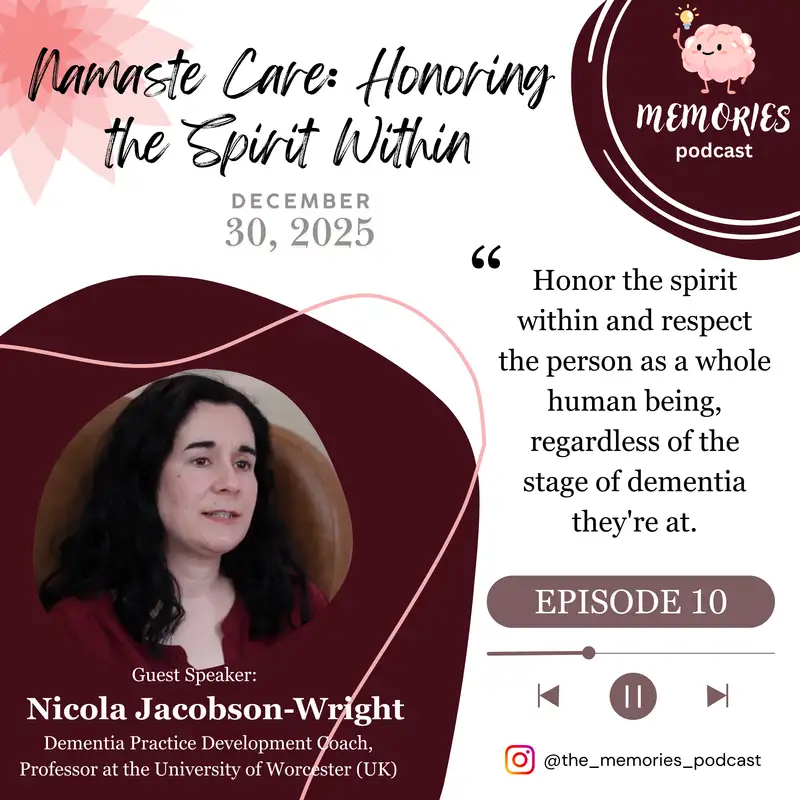
In today's episode, I'm delighted to welcome Nicola Jacobson Wright, a dementia practice development coach at the Association for Dementia Studies at the University of Worcester in the United Kingdom. Nicola is professionally trained in dance movement psychotherapy, and she has over 20 years of experience working in health and social care settings for those living with dementia. She's the founding director of Dance and Dementia, a nonprofit organization aimed to increase well-being
by providing opportunities for those affected by dementia to engage physically, socially, and emotionally through movement and dance. It's truly a gem to have you join us today, Nicola.
Nicola Jacobson-Wright (01:42)
Thank you for inviting me.
Jackson Nguyen (01:43)
Thank you. And before we get started, do you have anything else you would like to add or any specific questions you have for me before we get started?
Nicola Jacobson-Wright (01:51)
to get going.
Jackson Nguyen (01:51)
Okay, awesome. First off, how are you doing today, Nicola? Where are you joining us from and why has it been keeping you occupied recently?
Nicola Jacobson-Wright (01:58)
I'm well. I'm joining from Lancaster, which is in the north of England, so kind of on the way up towards Scotland. I've been busy working for the University of Worcester today, as I do on many days, and currently supporting lots of my students who are coming towards the end of their term and having to hand in their assignments.
Jackson Nguyen (02:23)
Take me back to the very beginning, like what had ultimately inspired you to become a dance movement psychotherapist and pursue a profession in transforming the lives of those living with dementia?
Nicola Jacobson-Wright (02:34)
So I guess dance therapy is sort of one aspect of what I do and my dance therapy work started because I have a background in working with people with dementia in care settings which I really enjoyed and I've always loved dance. I never trained as a professional dancer but just always enjoyed dance and music and
I had an opportunity to combine those two passions and to train in a Masters in Dance, Movement, Psychotherapy, which is what I did at Goldsmiths in London. And from there I built my work specifically working with people with dementia and using dance and movement as a way to be able to connect with people and enjoy.
Jackson Nguyen (03:16)
fascinating. Thank you so much, Nicola. What does the word like dementia personally mean to you?
Nicola Jacobson-Wright (03:22)
I think dementia is really really complicated. I think it's important to recognise that dementia is an umbrella term which covers hundreds of different types, subtypes of dementia and I think always important to come back to the words of Professor Tom Kitwood who said that when you've met one person with dementia, you've met one person with dementia and I think that's always a useful thing for us to remember because it's
incredibly complicated syndrome but also it affects each person very differently.
Jackson Nguyen (03:52)
I would love to tie dementia into one of your greatest passions, dance. I would love to hear the incredible work that you do at Dance and Dementia. It's truly a beautiful initiative aiming to engage those living with dementia, like movement and dance. Like what about movement and dance that makes this initiative so powerful?
Nicola Jacobson-Wright (04:11)
I think using, working with dance and movement is useful because it plays to people's continuing strengths. think that ⁓ where sometimes people might start to have difficulties with some of their cognitive skills that might affect their language ability, maybe some of their kind of thinking or memory, dance and movement taps into those.
parts of the brain that are still functioning well and also kind of obviously keeps the body active. So it feels like a very natural way to kind of continue to connect with somebody.
Jackson Nguyen (04:41)
And in your years of teaching, are some of the types of dance or movements or like types of music and rhythm that connect and engage people best?
Nicola Jacobson-Wright (04:49)
⁓
think coming back to the every person is different is an important thing to reiterate here because I think that the kind of dance that you might respond to, the kind dance that I might respond to, the kind of music that each of us would or anybody who's listening to this, it will be very individual and I think part of anything when you're working with someone with dementia is getting to know what is important to them, what's significant to them. So I think there will be things perhaps potentially in people's past where there's tradition
music or kind of music from somebody's particular times in someone's life that you know brings back different memories or you know kind of evokes different emotions so I think that would be important those would be important aspects to consider and then in terms of
forms of dance potentially if somebody has kind of been familiar with a particular form of dance or if they've grown up with ballroom dancing or line dancing or you know anything like that then it might be that that's something that really resonates with them but I think for me probably improvisation is the most useful form of dance because it doesn't rely on any instructions it doesn't rely on those kind of cognitive skills that someone might be finding more challenging so rather than kind of like you know two steps to the left
left,
one to the right, turn around, any sort of instructions like that are more likely to get any of us feeling a little bit confused, whereas if the instruction is to move to the music, it's a lot easier. We don't have to be thinking in that way, so yeah, just enjoying ourselves to the music.
Jackson Nguyen (06:23)
Thank you so much for sharing, Nicola. And next, I would like to shift towards the state of dementia prevalence, specifically in the United Kingdom. Like what's the existing state of the prevalence in care in the UK? Is there a similar rising prevalence in like the elder populations across the country as well?
Nicola Jacobson-Wright (06:41)
So yes, in the UK and just reflective of across the world really that we have an ageing population, people are living for longer and because age is the biggest risk factor for dementia it means that we have a growing population of people with dementia as well.
Jackson Nguyen (06:55)
And I'm assuming the UK also has like aged care homes that are similar to the United States like nursing homes and such
Nicola Jacobson-Wright (07:02)
Yes, that's right. various different kind of, we, we're obviously a lot of people with dementia are still living in their own homes in the community and the majority of people with dementia will be living in their own homes. But perhaps as dementia progresses, people might be more likely to move into some kind of a sheltered housing or extra care housing support or potentially into a care or nursing home.
Jackson Nguyen (07:24)
Moving on, I would love to transition to the very heart of your work, Namaste Care. When I hear the word Namaste, that really reminds me of something a yoga teacher would typically say with their legs crossed and their hands in a prayer position bowing down to you. When I did a quick Google search, it said it's a Sanskrit Hindu terminology that means I bow to you.
Beyond this meaning, I would love to hear your thoughts. What does namaste personally mean to you, Nicola?
Nicola Jacobson-Wright (07:53)
Okay, well.
Namaste Care was originally created by Joyce Simard who is in the US, she's based in Florida and Joyce came up with this approach which is a way of supporting people with the most advanced dementia and she referred to it as Namaste Care because the definition that she'd heard somebody describe Namaste was to honor the spirit within and she felt like that was a really appropriate message for what it was she was trying to do is to say that that person is still there, that we still want
to honour and respect that person as a whole human being, regardless of the stage of dementia that they're at. And so that's why she gave the programme, if you like, that title.
Jackson Nguyen (08:30)
And based on my understanding, Namaste Care, you know, it leverages this multi-sensory approach where you aim to stimulate, you know, the five senses, like using aromas, using lighting, music, and other sensory items to foster like connection and promote wellbeing in those living with like advanced dementia. Is this an accurate definition of like Namaste Care?
Nicola Jacobson-Wright (08:52)
Yes, I think that would be, I would say that that is an accurate definition. I think that one of the important aspects of Namaste Care is that it happens on a regular basis. So it's not about it being something that's just very occasional, because the point is that you're trying to meet people's emotional, social and psychological needs that it might be very challenging to meet in other ways. And so you want to be ensuring that that's happening on a regular basis. ideally on a daily basis, this would be something that would happen.
Jackson Nguyen (09:20)
Yeah. And I'm wondering how different is Namaste Care from sensory interventions because my passion is similarly rooted in sensory interventions. Like back last year, I had the privilege to conduct a qualitative study at WPI where we explored sensory stimulation interventions as a non-pharma approach to integrate into a local dementia nursing home in Worcester, Massachusetts.
And based on our interviews with 20 global experts and our systematic review, we realize how sensory interventions have this incredible potential. Considering that sensory deprivation has emerged to be one of the potential biomarkers of dementia, so these sensory stimulation interventions could be really key. And so I'm just wondering, I want to hear your thoughts on the difference and how, know, Namaste care either incorporates these sensory interventions and is different.
Nicola Jacobson-Wright (10:13)
⁓ I assume there's a huge crossover from what you've said. ⁓ think that Namaste Care is about bringing together all of those different aspects really, all of those, you know, kind of looking at...
Jackson Nguyen (10:17)
Mm-hmm.
Nicola Jacobson-Wright (10:24)
how to make the best use of people's sensory abilities, continuing sensory abilities. And I think one of the ways that I think about it sometimes is if we think about humans and how we've kind of grown and developed from babies and some of the skills that are innate and hardwired in us and some of the skills that we've had to develop. So we're born being able or kind of from very young, able to make eye contact, able to respond to touch, able to respond to...
the sound of somebody's voice to music.
Those things are very early for us to develop, they're really hardwired in our brains. And some of those other skills that we learn and develop, so some of the motor skills that we learn later on, some of the language skills that we learn later on, some of those things as dementia progresses, those things can be impacted, which means that we might have more difficulty having a conversation with somebody through language, but we still have those skills that we develop very early on, so we still have the ability
to make eye contact with somebody, we still have the ability to touch and be touched and to kind of have a need and response to human connection to another human. yeah, so I think Namaste Care kind of brings together all of those different sensory elements and I think also it's sort of...
alongside that, practitioners of Namaste Care would be encouraged to really think about their non-verbal communication, really think about working at a very slow pace so that they maximise the opportunity for being able to connect with somebody. But yeah, it certainly sounds like there's a huge amount of crossover between those different approaches.
Jackson Nguyen (12:01)
Yeah, and I think, you know, it's the sensory interventions in general, like they are so powerful because it truly helps those living with dementia, like connect with themselves and their environment so much better and help them feel less withdrawn and isolated.
Nicola Jacobson-Wright (12:14)
Absolutely.
Jackson Nguyen (12:14)
And in the three year study on the mass daycare in the United Kingdom that you conducted, I was wondering if you could share some of these great findings with our audience. Were there any particular results that surprised you the most?
Nicola Jacobson-Wright (12:26)
⁓ Yeah, I mean I think that the study was intended to try and help us to understand how to implement Namaste Care because we knew that there had already been some research done showing some positive outcomes from the approach and we wanted to look at within UK care homes if organisations wanted to introduce Namaste Care, what sort of things would they need to do to help that to happen.
So it's sort of exploratory in that way. And I think what we were surprised at was that we also collected a little bit of data to see whether there were any differences in people's quality of life or anything like that. And we saw some very significant changes. So from kind of pre and post the intervention, we saw improvements in people's quality of life and we saw decreases in levels of agitation. And it was just fantastic to be able to see that because it wasn't really our kind
like our primary aim but it was very reinforcing to see that it really does kind of make a huge difference to people.
Jackson Nguyen (13:27)
Yeah, and could you share with our audience like some of the components of a typical Namaste care space?
Nicola Jacobson-Wright (13:34)
Yeah, so ⁓ I guess because it's a sensory intervention, there are things that you would be thinking about to try and make sure that that environment was kind of stimulating to the senses. So you might want to think about something visual in that space. sometimes people might use a screen to have images, maybe not something with a story or a film or something like that, but just slow moving images of it could be a waterfall or it could be a fish tank or it
be in the middle of winter it might be like a roaring fire or something like that. And then also there might be an aroma in the space as well so you might be thinking about lavender or lemon or something that's going to create an atmosphere. And then you'll be thinking about the kind of sounds that you might want in that space. It might be that you have nature sounds happening, it might be that you have music, there's obviously a space
the quiet as well so you know it's really just kind of like having a thought about how we create that sort of atmosphere that will be, will, is going to be both stimulating and also kind of calming and supportive and I think the other thing is that within the Namaste Care space you want people to be very comfortable so you need to think about the kind of seating that's provided in there and to tailor it for the individuals that are going to be into that in that space and also making sure that there are
different
objects that you might want to interact with within that session. and I guess one of the other elements of Namaste Care, there's always sort of food and drinks, not so much thinking about nutrition and hydration, although that's a great extra outcome. But thinking about them in terms of like a sort of treat. So something that will be really enjoyable for somebody. So thinking about kind of food and drink treats that are available for people to ⁓ take part in.
Jackson Nguyen (15:00)
Mm-hmm.
Mm-hmm.
Yeah.
Yeah, I totally agree with you, especially with this idea of personalization, how, let's say, even using, you know, aromatherapy, one person might love the sense, one person might hate it. And so it's important, you know, to really personalize each of those sensory elements to each specific person.
Nicola Jacobson-Wright (15:35)
Exactly and also I think one of the things that Joyce talks about is thinking about the seasons as well, the changing seasons. So your Namaste Care Room might change depending on the time of year. So if it's in spring you might be bringing like blossoms and daffodils into that space or you you might in the summer you might have strawberries for people to eat or you know so you're changing kind of the things that are part of that session depending on the time of year as well.
Jackson Nguyen (15:55)
Mm-hmm.
Yeah, and what's the ideal frequency and the time of day that the Namaste care could best be implemented?
Nicola Jacobson-Wright (16:06)
So ideally this would be something that would be happening on a daily basis. I think Joyce's idea originally was that it would happen twice a day, although that's sometimes difficult for people to be able to manage. But if it's possible to do it on a daily basis, seems like our research found that once a day was enough to see an impact. And I think it depends quite a bit on the setting, whether it's happening in someone's own home, whether it's happening in a care home or in a hospital.
might depend on what's actually practical for the staff working in that home. It might be looking at whether there's a quieter time that it's easier for staff to be able to manage that. I haven't seen anything that says it's better for it to happen in the morning or the afternoon. I think it would be interesting to see it used a little bit more in the evenings as a way to support people to feel little bit calmer towards heading to bed.
Jackson Nguyen (16:59)
Yeah. And I'm not sure if you're familiar, but there's also this concept called snoezelen and it's, think it's also developed. I was in the Netherlands, I believe. but like, would love to hear your stance on like, cause it's snoozing and it's a multi-sensory environment as well. It's a trademark name, of course, like these technologies, you know, they could be highly costly to implement. ⁓ and so for nursing facilities who may not have this day, this money, like what would be your recommendation?
to integrate Namaste- care, and the sensory components into their living space.
Nicola Jacobson-Wright (17:30)
So I think again there's a lot of crossover and there's certainly potential benefits in having that sort of sensory space. I think what we found with Namaste Care is that it's generally quite low cost because you don't really need any kind of specialist equipment or anything like that. You know, don't need lots of different things to create a sensory space. And I think the one thing I would say is that the space won't do the caring.
So having a sensory space is lovely, but you do need the people in there, the professionals in there that will actually kind of be supportive and be interacting with people. The environment itself, although it's helpful, it's not going to make the difference on its own. So I think that certainly I've seen in the UK, sometimes people creating sensory rooms in care settings and then them not being used because they're not part of
Jackson Nguyen (17:54)
Mm-hmm.
Mm-hmm.
Nicola Jacobson-Wright (18:21)
the structure of a care day and I think what Namaste Care does is it says this is something that is integral to our care day and therefore we need to think about how do we not just create the right room and environment but how do we make sure that it's timetabled in and that happens every day and that there are staff allocated to support that session happening because otherwise that room just won't be used.
Jackson Nguyen (18:42)
Yeah, and I feel like that's also common here in the US too, like a lot of get built but like they kind of just, sometimes nursing homes you would spend thousands of dollars to, you know, create these highly structured, like multi-sensory rooms and then they kind of just be left in dust and no one's using them, it's kind of go to waste.
Nicola Jacobson-Wright (18:59)
I think the bridge between environment and how we use the environment is a really important one and you can say the same for things like gardens. Sometimes people spend huge amounts of money on creating a really beautiful outdoor space but if we don't know how to use that space, we don't feel confident to keep the doors open, to encourage people to come outside, to create activities that are happening outdoors, then we'll have this beautiful space that doesn't get used.
Jackson Nguyen (19:24)
And with non-pharmaceutical approaches like Namaste care and others, like these types of interventions, I feel like they don't get as wide of attention compared to like pharmaceutical dimensions. Unfortunately, I feel like research in the field of these non-pharmaceutical approaches, like they pale in comparison, you know, to those pharmaceutical due to like their skepticism, like which leads to like a lack of investment and therefore limited breakthroughs. Because some people like question, do they actually work?
and stuff like that and why do you think this is the case and what are some of the ways we could do to help like reverse this.
Nicola Jacobson-Wright (19:57)
Cool, that's a complicated question. I think there's probably multi-layered the reasons why, and I think there's a lot that's historical. think we perhaps have in common in the UK and in the US a strong leaning towards a medical model and kind of a great respect for medical practitioners. And that includes...
pharmaceutical solutions and I think people have a tendency to want a kind of shortcut in the hope that somehow something that is like a medicine will make things better and unfortunately life is often a little bit more complicated than that and maybe we need a different solution and I think we don't like to look at the fact that sometimes those kind of like pharmaceutical or pharmacological ⁓
solutions, if we can call them solutions, that sometimes they're not very effective, but we don't necessarily want to hear that they're not very effective. And also they often come with a lot of risk factors, a lot of side effects. And so I think we kind of have a bit of an upward battle to try and kind of shift the culture to say the medical model isn't always the solution, you know, sometimes it doesn't work very well. And it comes with all these extra
Jackson Nguyen (20:44)
Mm-hmm.
Mm-hmm.
Mm-hmm.
Nicola Jacobson-Wright (21:03)
side effects and risk factors. I'm not aware of any side effects or risk factors associated with prescribing Namaste Care. It's very safe.
So it has less advantage to it. I think the other thing in terms of funding is that of course there's a lot of money involved in pharmaceutical solutions and that means that there's money that can be used to research those and to promote those whereas the non-pharmacological methods don't have the same funding behind them.
Jackson Nguyen (21:19)
Mm-hmm.
Yeah, I completely agree with you. I feel like our society in general, like especially in Western, like the US and the UK, like we have evolved to like favor medication sort of like as a bandage approach to the culture of care. And I'm personally a big advocate to resist the usage of antipsychotics and like medications like when necessary, because I believe that these drugs, you know, they are often prescribed inappropriately and the side effects they have like maybe more harmful and good. And so
I think it's important that we, as we progress in the future to advocate for, to reduce these antipsychotics and medications in the culture of care.
And obviously we live in a world where we are constantly inundated with tasks, information and everything. We're constantly on the go and it's not uncommon for staff to be emotionally drained and burned out sometimes. And sometimes they prioritize the task as opposed to the person. implementing the Namaste care sounds very remarkable in theory, but how would this look like in practice, especially when
where a lot of nursing homes tend to be under staff. Sometimes the staff are burnt out. And I would love to hear your thoughts on that.
Nicola Jacobson-Wright (22:40)
a massive challenge. is a massive challenge. think Namaste Care is probably an approach to use if you're already managing to meet a reasonable level of dementia care, person-centred dementia care. think if you were trying to try to introduce it into a setting where the staff were already very stressed, where they were already struggling to meet people's daily needs.
Jackson Nguyen (23:00)
Mm-hmm.
Nicola Jacobson-Wright (23:06)
then I think it would.
have the effect of making staff feel more stressed and more pressured and it probably wouldn't be very achievable. And in our research study we had six case study care homes that we worked with and we were very careful to select homes that had a stable management that were already doing reasonably well at delivering person-centred dementia care because we're aware from introducing all sorts of different
Jackson Nguyen (23:30)
Mm-hmm.
Nicola Jacobson-Wright (23:33)
approach is that there needs to be some stability and functionality happening already before you try and bring something new in.
Jackson Nguyen (23:42)
Yeah. Thank you, Nicola And next, I want to transition to one of your other projects called FITS or the Focus Intervention Training and Support. And so based on the program, know, FITS has been successful in reducing the use of antipsychotics in these care homes by like 30%, I believe. It's truly remarkable progress. And in your opinion, like how did our society
get to this point of using so much of these anti-psychotics and these medications in the first place. And do you think there is a balance? Is there a fine balance between pharma versus non-pharma interventions in the culture of care?
Nicola Jacobson-Wright (24:18)
I mean I think the use of antipsychotics in dementia in particular is sort of concerning because
you know, these are medications that were created to try and deal with psychosis. They were never intended for people with dementia. They were intended for people who have conditions like schizophrenia, where, you know, an antipsychotic medication is hopefully going to be helpful in that circumstance. But I think that there's a lack of understanding of why people with dementia might sometimes...
kind of experience things in a certain way or behave in certain ways and because people don't understand they want to sort of find a way to stop people responding in those ways and an antipsychotic is something that's been used for a long time to essentially sedate people and stop them from being able to do all sorts of different things.
So, yeah, so I think there's something problematic in the first place in that this isn't even a medication that was created for this purpose and then it's been misused. And I think often if we have a little bit of an understanding of the person, of their dementia, of the triggers behind what's happening, then we can find solutions that are not to do with that medication.
Jackson Nguyen (25:12)
Yeah.
Mm-hmm.
Nicola Jacobson-Wright (25:37)
and we know that antipsychotics have some not very pleasant side effects but also you're at a highly increased risk of dying if you're put onto an antipsychotic so it's not a safe medication for someone to use, absolutely has to be a last resort.
Jackson Nguyen (25:54)
Yeah, I completely agree with you. feel like there's this like sedation question where, you know, sometime when we want to like when a physician gives a resident like ⁓ an antipsychotic to help them, you know, calm down and be more relaxed. like, are they just too, you know, whether the resident are just too sedated to respond to. We misconcept this sedation for relaxation. So it's like a really interesting.
Nicola Jacobson-Wright (26:22)
Yeah.
Jackson Nguyen (26:22)
⁓
and so I feel like our society has really favored that and, but like it's generally like a lot of these symptoms that arise, I feel like it's due to like the unmet needs. And I feel like what's so powerful with like the Namaste care, like we met and talked about is how it's able to, you know, meet some of these needs and help people connect to themselves and to their environment and others better.
Nicola Jacobson-Wright (26:43)
Yeah, absolutely.
Jackson Nguyen (26:44)
And as we start to wrap up, like if you could change one thing how dementia care is approached today, whether it's in policy, whether it's in healthcare or the culture of care, what would it
Nicola Jacobson-Wright (26:56)
one thing is very difficult but I guess it would be probably kind of echoing what I started with really just to kind of like recognise the person and recognise the complexity of dementia that this isn't one thing that it's many many different conditions that create that syndrome. Yeah so I think probably a
Jackson Nguyen (27:05)
Mm-hmm.
Nicola Jacobson-Wright (27:16)
A more person-centred approach would be great to see and a move away from that medical model, that one size fits all solution.
Jackson Nguyen (27:25)
Thank you, Nicola. And if listeners could remember just one takeaway from our amazing conversation today, what would you want it to be?
Nicola Jacobson-Wright (27:33)
I guess take some time to get to know the person. If you have somebody in your life, whether it's a family member or whether it's a friend or somebody that you're working with, take the time to really get to know that person. Remember that dementia is just one aspect of that person. It's not the whole of who they are.
Jackson Nguyen (27:54)
Thank you, Nicola. And my final question, like what's next for you as 2025 is about to end? Like what's next for you in 2026? Like what's something that you're excited for that's coming up for you?
Nicola Jacobson-Wright (28:06)
Okay so
What do we have? In the new year I will be introducing some new students onto our postgraduate certificate in dementia studies. we run a module which starts in January which is based on the FITS research and enables people to become dementia practice development coaches so that they can teach others about person-centred dementia care, non-pharmacological approaches, reducing antipsychotics and it's like a cascading training
Jackson Nguyen (28:15)
Mm-hmm.
Nicola Jacobson-Wright (28:33)
model that means that they can teach other people who can then share the message and teach more people. So that's exciting. So I'll have a group of students that are just completing that module now and they'll be handing in their final assignments in January and a new group of students that will be starting off in the middle of January. We also have our next Namaste Care training happening in January as well. So I'll be meeting some new people who are wanting to introduce Namaste Care.
⁓ And I should say, even though I'm all the way over in the UK, all of the courses that we teach, including the postgraduate certificate and the Namaste training is all fully online. So anybody in the world can access those courses. You can have a look at the Worcester University website and find out more about those things. And I'll be talking at the Marie Curie conference in March, I want to say.
Jackson Nguyen (29:10)
you
Nicola Jacobson-Wright (29:22)
⁓ It's free, it's online and we'll be presenting there about Namaste Care and some of work we've been doing. I can share some of those links with you to share with your audience.
Jackson Nguyen (29:23)
That's incredible.
Thank you so much, Nicola. Thank you so much for sharing. But it's been a pleasure to be with you today. Thank you so much for sharing your insights, your experience, and your empathy with us in today's episode. I appreciate you very much, Nicola. And wishing you a Merry Christmas.
Nicola Jacobson-Wright (29:53)
And you Jackson, thank you very much for creating these podcasts.
Jackson Nguyen (29:57)
Thank you so much.